MCQ
In an intrinsic semiconductor, conductivity is:
- ALow at room temperature
- BAverage
- CHigh at room temperature
- DZero at room temperature
Explanation:
In intrinsic semiconductors, n = p. Hence, at room temperature, no free electrons are available for conduction. If the temperature is increased, the covalent bonds will break and electrons will be freed, each electron will leave behind a hole and capture a new hole the process will continued and charge flows through intrinsic semiconductor.
Thus, its conductivity increases with temperature. Hence, in intrinsic semiconductor conductivity is low at room temperature.
Generate a complete, print-ready paper with questions like this in minutes — across 16+ boards, with answer keys.
Focal length of a plane mirror is
|
(a) Zero |
(b) Infinite |
(c) Very less |
(d) Indefinite |
A P-type semiconductor has acceptor levels 57 meV above the valence band. The maximum wavelength of light required to create a hole is (Planck’s constant h = 6.6  J-s)
J-s)
|
(a) 57 |
(b) 57 |
(c) 217100 |
(d) 11.61 |
A light bulb, a capacitor and a battery are connected together as shown here, with switch S initially open. When the switch S is closed, which one of the following is true
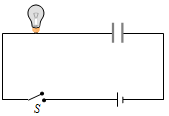
|
(a) The bulb will light up for an instant when the capacitor starts charging |
|
(b) The bulb will light up when the capacitor is fully charged |
|
(c) The bulb will not light up at all |
|
(d) The bulb will light up and go off at regular intervals |
The light reflected by a plane mirror may form a real image
|
(a) If the rays incident on the mirror are diverging |
|
(b) If the rays incident on the mirror are converging |
|
(c) If the object is placed very close to the mirror |
|
(d) Under no circumstances |
The electric intensity E, current density j and specific resistance k are related to each other by the relation
|
(a) E = j/k |
(b) E = jk |
(c) E = k/j |
(d) k = jE |


