MCQ
In an isothermal process the volume of an ideal gas is halved. One can say that
  • A
    Internal energy of the system decreases
  • B
    Work done by the gas is positive
  • Work done by the gas is negative
  • D
    Internal energy of the system increases

Answer

Correct option: C.
Work done by the gas is negative
c
(c) For isothermal process
$dU = 0$ and work done $ = dW = P({V_2} - {V_1})$
$\;{V_2} = \frac{{{V_1}}}{2} = \frac{V}{2}$

$dW = - \frac{{PV}}{2}$

Need a full question paper?

Generate a complete, print-ready paper with questions like this in minutes — across 16+ boards, with answer keys.
Start Generating Free

Similar questions

If one mole of the polyatomic gas is having two vibrational modes and $\beta$ is the ratio of molar specific heats for polyatomic gas $\left(\beta=\frac{ C _{ P }}{ C _{ v }}\right)$ then the value of $\beta$ is:
Two spherical bodies $\mathrm{A}$ (radius $6 \mathrm{~cm}$ ) and $\mathrm{B}$ (radius $18 \mathrm{~cm}$ ) are at temperature $\mathrm{T}_1$ and $\mathrm{T}_2$, respectively. The maximum intensity in the emission spectrum of $\mathrm{A}$ is at $500 \mathrm{~nm}$ and in that of $\mathrm{B}$ is at $1500 \mathrm{~nm}$. Considering them to be black bodies, what will be the ratio of the rate of total energy radiated by $A$ to that of $B$ ?
A certain amount of an ideal monatomic gas needs $20 \,J$ of heat energy to raise its temperature by $10^{\circ} C$ at constant pressure. The heat needed for the same temperature rise at constant volume will be ........ $J$
An aluminium rod having a length $100 \,cm$ is clamped at its middle point and set into longitudinal vibrations. Let the rod vibrate in its fundamental mode. The density of aluminium is $2600 \,kg / m ^3$ and its Young's modulus is $7.8 \times 10^{10} \,N / m ^2$. The frequency of the sound produced is .............. $Hz$
A block weighs $W$ is held against a vertical wall by applying a horizontal force $F$. The minimum value of $F$ needed to hold the block is $[\mu < 1]$
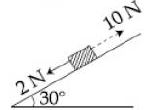
A block kept on a rough inclined plane, as shown in the figure, remains at rest upto a maximum force $2\,N$ down the inclined plane. The maximum external force up the inclined plane that does not move the block is $10\,N.$ The coefficient of static friction between the block and the plane is : [Take $g = 10\,m/s^2$ ]
Suppose the medium in the previous question is water. Select the correct option$(s)$ from the list given in that question.
If the change in the value of $‘g’$ at a height $h$ above the surface of the earth is the same as at a depth $x$ below it, then (both $x$ and $h$ being much smaller than the radius of the earth)
The velocity of a body moving with a uniform acceleration of $2\,\,m/{\sec ^2}$ is $10\,\,m/\sec $. Its velocity after an interval of $4 \,sec$ is...........$m/\sec $
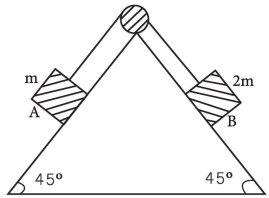
Consider the diagram shown below in which two masses of $m$ and $2 m$ are placed on a fixed triangular wedge. The coefficient of friction between block $A$ and the wedge is $2 / 3$, while that for block $B$ and the wedge is $1 / 3$