Question
In astronomical observations, signals observed from the distant stars are generally weak. If the photon detector receives a total of $3.15 \times 10^{–18}J$ from the radiations of $600nm$, calculate the number of photons received by the detector.
Answer

From the expression of energy of one photon (E),
$\text{E}=\frac{\text{hc}}{\lambda}$
Where,
$\lambda$ = wavelength of radiation
h = Planck’s constant
c = velocity of radiation
Substituting the values in the given expression of E:
$\text{E}=\frac{(6.626\times10^{-34}\text{Js})(3\times10^8\text{ms}^{-1})}{(600\times0^{-9}\text{m})}$
$E = 3.313 \times 10^{–19}J$
Energy of one photon = $3.313 \times 10^{–19}J$
Number of photons received with $3.15 \times 10^{–18}J$ energy
$=\frac{3.15\times10^{-18}\text{J}}{3.313\times10^{-19}\text{J}}$
$=9.5$
$\approx10$

Need a full question paper?

Generate a complete, print-ready paper with questions like this in minutes — across 16+ boards, with answer keys.

Start Generating Free

Similar questions

Explain the different necessary steps to calculate the concentrations of different reactants and products at equilibrium for reversible reaction.
Describe graphically the measurement of change in internal energy $(\Delta U )$ by bomb calorimeter.
The pH of 0.1M solution of cyanic acid (HCNO) is 2.34. Calculate the ionization constant of the acid and its degree of ionization in the solution.
$\text{K}_{\text{c}}\text{ for }\text{PCl}_5(\text{g})\rightleftharpoons\text{PCl}_3(\text{g})+\text{Cl}_2(\text{g})\text{ is }0.04\text{ at }25^\circ\text{C}.$
How much moles of $PCl_5$ must be added to 3L flask to obtain a chlorine concentration of $0.15M$.
Note: Consider structures I to VII and answer the questions:
  1. $\text{CH}_3-\text{CH}_2-\text{CH}_2-\text{CH}_2-\text{OH}$
  2. $\text{CH}_3-\text{CH}_2-\text{CH}-\text{CH}_3\\\ \ \ \ \ \ \ \ \ \ \ \ \ \ \ \ \ \ \ \ \ \ \ \ \ \ |\\\ \ \ \ \ \ \ \ \ \ \ \ \ \ \ \ \ \ \ \ \ \ \ \ \ \text{OH}$
  3. $\ \ \ \ \ \ \ \ \ \ \ \ \text{CH}_3\\\ \ \ \ \ \ \ \ \ \ \ \ \ |\\\text{CH}_3-\text{C}-\text{CH}_3\\\ \ \ \ \ \ \ \ \ \ \ \ \ |\\\ \ \ \ \ \ \ \ \ \ \ \ \text{OH}$
  4. $\text{CH}_3-\text{CH}-\text{CH}_2-\text{OH}\\\ \ \ \ \ \ \ \ \ \ \ \ \ \ \ \ \ \ \ \ \ \ \ \ |\\\ \ \ \ \ \ \ \ \ \ \ \ \ \ \ \ \ \ \ \ \ \ \ \text{CH}_3$
  5. $\text{CH}_3-\text{CH}_2-\text{O}-\text{CH}_2-\text{CH}_3$
  6. $\text{CH}_3-\text{O}-\text{CH}_2-\text{CH}_2-\text{CH}_3$
  7. $\text{CH}_3-\text{O}-\text{CH}-\text{CH}_3\\\ \ \ \ \ \ \ \ \ \ \ \ \ \ \ \ \ \ \ \ \ \ |\\\ \ \ \ \ \ \ \ \ \ \ \ \ \ \ \ \ \ \ \ \ \text{CH}_3$
Which of the above compounds form pairs of metamers?
Attempt any five of the following:
1. Why are Alkenes called olefins?
2. Convert 1-bromopropane to 2-bromopropane.
3. If Qc < Kc, when we continuously remove the product, what would be the direction of the reaction?
4. Convert methane into ethane.
5. What are cycloalkanes?
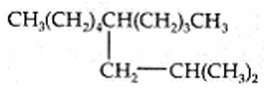
6. Write IUPAC name of following:
Image
7. How will you convert ethanoic acid into ethene?
$34.05mL$ of phosphorus vapour weighs $0.0625g$ at $546°C$ and $0.1$ bar pressure. What is the molar mass of phosphorus?
S. No
Column I
Column II
1.
$[Mn(CO)_5]^-$
+6
2.
$[Mn_2(CO)_{10}]$
+2
3.
$K_4[Mn(CN)_6]$
0
4.
$K_2MnO_4$
-1
The equilibrium constant for the following reaction is $1.6 \times 10^5$ at 1024K $\text{H}_2\text{ (g) + Br (g)}\rightleftharpoons2\text{HBr (g)}$ Find the equilibrium pressure of all gases if 10.0 bar of HBr is introduced into a
sealed container at 1024K.
Discuss and compare the trend in ionisation enthalpy of the elements of group1 with those of group17 elements.