Question

In Bainbridge mass spectrograph a potential difference of 1000 V is applied between two plates distant 1 cm apart and magnetic field in B = 1T. The velocity of undeflected positive ions in m/s from the velocity selector is

(a)  

(b)  

(c)  

(d)  

Answer

(c)  

Need a full question paper?

Generate a complete, print-ready paper with questions like this in minutes — across 16+ boards, with answer keys.

Start Generating Free

Similar questions

If identical charges (-q) are placed at each corner of a cube of side b, then electric potential energy of charge (+q)  which is placed at centre of the cube will be

(a)  

(b)

(c)

(d)

A parallel plate capacitor of plate area A and plate separation d is charged to potential V and then the battery is disconnected. A slab of dielectric constant k is then inserted between the plates of the capacitors so as to fill the space between the plates. If Q, E and W denote respectively, the magnitude of charge on each plate, the electric field between the plates (after the slab is inserted) and work done on the system in question in the process of inserting the slab, then state incorrect relation from the following

(a)  

(b)

(c)

(d)

A metallic particle having no net charge is placed near a finite metal plate carrying a positive charge. The electric force on the particle will be:
  1. Towards the plate.
  2. Away from the plate.
  3. Parallel to the plate.
  4. Zero.

Which of the following is the fusion reaction

(a)   

(b)  

(c)  

(d)  

If a resistance  is connected in parallel with the resistance R in the circuit shown, then possible value of current through R and the possible value of   will be

(a)  

(b) I, 2R

(c)  

(d)  

In the circuit shown below,  The reading of the voltmeter V is

(a) 12 V   

(b) 8 V

(c) 20 V

(d) 16 V

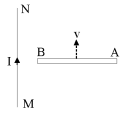
In the given figure, conducting rod AB is moved in the direction of magnetic field developed by the current carrying conductor MN. The direction of generated induced current will be:
Image

In a tangent galvanometer a current of 0.1 A produces a deflection of 30o. The current required to produce a deflection of 60o is

(a) 0.2 A 

(b) 0.3 A

(c) 0.4 A  

(c) 0.5 A

Anelectron is revolving in an orbit of radius $5.1 \times 10^{-11} m$ is revolving with a frequency of $6.8 \times 10^{15} cycles / second$. The magnitude of equivalent current is :
The thermal radiation emitted by a body is proportional to Tn where Tis its absolute temperature. The value of n is exactly 4 for:
  1. A blackbody.
  2. All bodies.
  3. Bodies painted black only.
  4. Polished bodies only.