MCQ
In capillary pressure below the curved surface of water will be
  • A
    Equal to atmospheric
  • B
    Equal to upper side pressure
  • C
    More than upper side pressure
  • Lesser than upper side pressure

Answer

Correct option: D.
Lesser than upper side pressure
d
(d) In capillary pressure below curved surface is less than upper side pressure.

Need a full question paper?

Generate a complete, print-ready paper with questions like this in minutes — across 16+ boards, with answer keys.
Start Generating Free

Similar questions

$v_1$ is the frequency of the series limit of Lyman series, $v_2$  is the frequency of the first line of Lyman series and  $v_3$ is the frequency of the series limit of the Balmer series. Then
There is a uniformly charged non conducting solid sphere made of material of dielectric constant one. If electric potential at infinity be zero, then the potential at its surface is $V$. If we take electric potential at its surface to be zero, then the potential at the centre will be
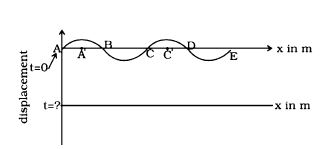
The pattern of standing waves formed on a stretched string at two instants of time (extreme,mean) are shown in figure. The velocity of two waves superimposing to form stationary waves is $360\  ms^{-1}$ and their frequencies are $256\  Hz$. Which is not possible value of $t$ (in $sec$)
When a particle moves in a uniform circular motion. It has
A convergent beam of light is incident on a convex mirror so as to converge to a distance $12\, cm$ from the pole of the mirror. An inverted image of the same size is formed coincident with the virtual object. What is the focal length of the mirror......$cm$
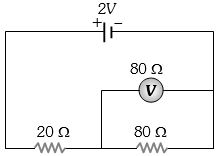
In the adjoining circuit, the $e.m.f.$ of the cell is $2\, volt$ and the internal resistance is negligible. The resistance of the voltmeter is $80 \,ohm$. The reading of the voltmeter will be ............. $volt$
A particle of mass $1 \,{mg}$ and charge $q$ is lying at the mid-point of two stationary particles kept at a distance $'2 \,{m}^{\prime}$ when each is carrying same charge $'q'.$ If the free charged particle is displaced from its equilibrium position through distance $'x'$ $(x\,< \,1\, {m})$. The particle executes $SHM.$ Its angular frequency of oscillation will be $....\,\times 10^{8}\, {rad} / {s}$ if ${q}^{2}=10\, {C}^{2}$
A particle $A$ of mass $‘m’$ and charge $‘q’$ is accelerated by a potential difference of $50\, V$. Another particle $B$ of mass $‘4\, m’$ and charge $‘q’$ is accelerated by a potential difference of $2500\, V$. The ratio of de-Broglie wavelength $\frac{{{\lambda _A}}}{{{\lambda _B}}}$ is close to
A ball falling in a lake of depth $200\, m$ shows $0.1\%$ decrease in its volume at the bottom. What is the bulk modulus of the material of the ball
In hydrogen atom, electron makes transition from $n=4$ to $n=1$ level. Recoil momentum of the $H$ atom will be