MCQ
In case of closed organ pipe which harmonic the $p^{th}$ overtone will be
  • $2{p + 1}$
  • B
    $2{p - 1}$
  • C
    $p + 1$
  • D
    $p - 1$

Answer

Correct option: A.
$2{p + 1}$
a
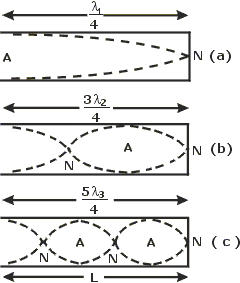
In the fundamental mode of vibration, the air column vibrates with an antinode A at the open end and a node $N$ at the closed end as shown in figure $(a).$ since the distance between a node and an antinode is $\frac{\lambda}{4}$, the length of the tube lin this case will be equal to $\frac{\lambda}{4}$ $l=\frac{\lambda}{4}$

$\lambda=4 l$

The velocity of wave is given by$:$

$v=\nu_{0} \lambda$

$\nu_{0}=\frac{v}{\lambda}=\frac{v}{4 l}$

This is ( $\nu_{0}$ ) the frequency of the fundamental note is called the first harmonic: (For zero overtone).

Figure $(b)$ shows the first overtone in a closed pipe. Two nodes and two antinodes are formed. The wavelength and the frequency of the sound corresponding to this mode of vibration will be different from those corresponding to the fundamental mode. the length of the tube lin this case will be equal to $\frac{3 \lambda}{4}$.

$l=\frac{3 \lambda}{4}$

$\lambda=\frac{4 l}{3}$

The velocity of wave is given by$:$

$v=\nu_{1} \lambda$

$\nu_{1}=\frac{v}{\lambda}=\frac{3 v}{4 l}$

This is $\left(\nu_{1}\right)$ the frequency of the'second harmonic: (For first overtone).

Further, the frequency $\nu_{2}=\frac{5 v}{4 l}$ is of the third harmonic. (For second overtone).

Hence, for $p^{t h}$ overtone the frequency will be only an odd harmonic(integral multiple) of fundamental frequency.

$\nu_{p}=(2 p+1) \frac{v}{4 l}=(2 p+1) \nu_{0}$

In case of closed organ pipe the $p^{t h}$ overtone will be $(2 p+1)$ harmonic.
Need a full question paper?

Generate a complete, print-ready paper with questions like this in minutes — across 16+ boards, with answer keys.
Start Generating Free

Similar questions

Consider the motion of the tip of the second hand of a clock. In one minute (R be the length of second hand), its ......
The maximum wavelength of radiation emitted at $2000\;K$is $4\mu m$. What will be the maximum wavelength of radiation emitted at $2400\,K$ is ...... $\mu m$
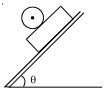
$A$ plank of mass $M$ is placed over smooth inclined plane and $a$ sphere is also placed over the plank. Friction is sufficient between sphere and plank. If plank and sphere are released from rest, the frictional force on sphere is:
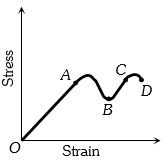
In the below graph, point $B$ indicates
A simple pendulum of length $l$ and mass $m$ of the bob is suspended in a car that is travelling with a constant speed $v$ around a circular path of radius $R$. If the pendulum undergoes oscillations with small amplitude about its equilibrium position, the frequency of its oscillations will be
Consider a planet in some solar system which has a mass double the mass of the earth and density equal to the average density of the earth. An object weighing $W$ on the earth will weight.
The moment of inertia of a regular circular disc of mass $0.4\, kg$ and radius $100\, cm$ about an axis perpendicular to the plane of the disc and passing through its centre is ...... $kg\, m^2$
If $v$ is the speed of sound in air then the shortest length of the closed pipe which resonates to a frequency $n$
The total energy of a particle executing simple harmonic motion is
Radiation from a black body at the thermodynamic temperature $T_1$ is measured by a small detector at distance $d_1$ from it. When the temperature is increased to $T_2$ and the distance to $d_2$ , the power received by the detector is unchanged . What is the ratio $d_2/d_1$ ?