MCQ
In case of closed organ pipe which harmonic the $p^{th}$ overtone will be
  • $2{p + 1}$
  • B
    $2{p - 1}$
  • C
    $p + 1$
  • D
    $p - 1$

Answer

Correct option: A.
$2{p + 1}$
a
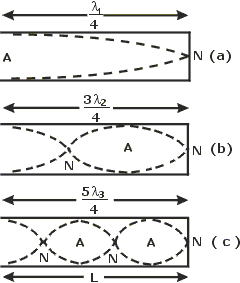
In the fundamental mode of vibration, the air column vibrates with an antinode A at the open end and a node $N$ at the closed end as shown in figure $(a).$ since the distance between a node and an antinode is $\frac{\lambda}{4}$, the length of the tube lin this case will be equal to $\frac{\lambda}{4}$ $l=\frac{\lambda}{4}$

$\lambda=4 l$

The velocity of wave is given by$:$

$v=\nu_{0} \lambda$

$\nu_{0}=\frac{v}{\lambda}=\frac{v}{4 l}$

This is ( $\nu_{0}$ ) the frequency of the fundamental note is called the first harmonic: (For zero overtone).

Figure $(b)$ shows the first overtone in a closed pipe. Two nodes and two antinodes are formed. The wavelength and the frequency of the sound corresponding to this mode of vibration will be different from those corresponding to the fundamental mode. the length of the tube lin this case will be equal to $\frac{3 \lambda}{4}$.

$l=\frac{3 \lambda}{4}$

$\lambda=\frac{4 l}{3}$

The velocity of wave is given by$:$

$v=\nu_{1} \lambda$

$\nu_{1}=\frac{v}{\lambda}=\frac{3 v}{4 l}$

This is $\left(\nu_{1}\right)$ the frequency of the'second harmonic: (For first overtone).

Further, the frequency $\nu_{2}=\frac{5 v}{4 l}$ is of the third harmonic. (For second overtone).

Hence, for $p^{t h}$ overtone the frequency will be only an odd harmonic(integral multiple) of fundamental frequency.

$\nu_{p}=(2 p+1) \frac{v}{4 l}=(2 p+1) \nu_{0}$

In case of closed organ pipe the $p^{t h}$ overtone will be $(2 p+1)$ harmonic.
Need a full question paper?

Generate a complete, print-ready paper with questions like this in minutes — across 16+ boards, with answer keys.
Start Generating Free

Similar questions

The equation of a wave travelling on a string is $y = 4\sin \frac{\pi }{2}\left( {8t - \frac{x}{8}} \right)$. If $x$ and $y$ are in $cm,$ then velocity of wave is
A moving coil galvanometer has $N$ number of turns in a coil of effective area $A$, it carries a current $I$. The magnetic field $B$ is radial. The torque acting on the coil is
The ratio of intensities between two coherent soud sources is $4 : 1$. The differenmce of loudness in $dB$ between maximum and minimum intensities when they interfere in space is:
The quantity of heat which crosses unit area of a metal plate during conduction depends upon
Choose the correct statement $(s)$ related to the motion of object and its image in the case of mirrors
A source of frequency $\nu$ gives $5$ beats/second when sounded with a source of frequency $200 \;Hz$. The second harmonic of frequency $2\nu$ of source gives $10$ beats/second when sounded with a source of frequency $420\; Hz$. The value of $v$ is .... $Hz$
The light rays having photons of energy $4.2\,eV$ are falling on a metal surface having a work function of $2.2\,eV$. The stopping potential of the surface is $.........\,V$
The pressure applied from all directions on a cube is $P$. How much its temperature should be raised to maintain the original volume $?$ The volume elasticity of the cube is $\beta $ and the coefficient of volume expansion is $\alpha $
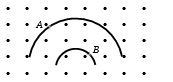
Two particles $A$ and $B$ of masses ${m_A}$ and ${m_B}$ respectively and having the same charge are moving in a plane. A uniform magnetic field exists perpendicular to this plane. The speeds of the particles are ${v_A}$ and ${v_B}$ respectively, and the trajectories are as shown in the figure. Then
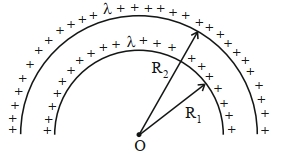
The electric potential at the centre of two concentric half rings of radii $R_1$ and $R_2$, having same linear charge density $\lambda$ is