MCQ
In case of earth:
  • A
    Potential is minimum at the centre.
  • B
    Potential is zero, both at centre and infinity.
  • C
    Field is zero both at centre and infinity.
  • D
    Potential is same, both at centre and infinity but no zero.

Answer

  1. Potential is minimum at the centre.
  1. Field is zero both at centre and infinity.

Need a full question paper?

Generate a complete, print-ready paper with questions like this in minutes — across 16+ boards, with answer keys.
Start Generating Free

Similar questions

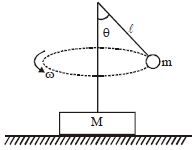
$A$ bob of mass $m$ is attached to a string whose other end is tied to a light vertical rod as shown in figure. The bob is swinging in horizontal plane with constant angular speed $\omega$. The vertical rod is supported on a block of mass $M$ which is placed on a rough surface. What is minimum friction coefficient between ground and block for which block does not slip ?
One mole of an ideal monoatomic gas at temperature $T_0$ expands slowly according to the law $P/V$ = constant. If the final temperature is $2 \,\,T_0$, heat supplied to the gas is :
If the water falls from a dam into a turbine wheel $19.6\, m$ below, then the velocity of water at the turbine is ............. $\mathrm{m/s}$ $(g = 9.8\,m/{s^2})$
A simple pendulum of mass $m$ executes $S.H.M.$ with total energy $E$. If at an instant it is at one of extreme positions, then its linear momentum after a phase shift of $\frac{\pi}{3} \,rad$ will be
$A$ block of mass $m$ is hung vertically from an elastic thread of force constant $mg/a$. Initially the thread was at its natural length and the block is allowed to fall freely. The kinetic energy of the block when it passes through the equilibrium position will be :
A body executing $S.H.M.$ along a straightline has a velocity of $3 \,ms ^{-1}$ when it is at a distance of $4 \,m$ from its mean position and $4 \,ms ^{-1}$ when it is at a distance of $3 \,m$ from its mean position. Its angular frequency and amplitude are
In which of the following systems will the wavelength corresponding to n = 2 to n = 1 be minimum?
  1. Hydrogen atom.
  2. Deuterium atom.
  3. Singly ionized helium.
  4. Doubly ionized lithium.
An ideal gas is filled in a vessel, then
The Brownian Motion was discovered by the scientist:
A body starts from the origin and moves along the $X-$axis such that the velocity at any instant is given by $(4{t^3} - 2t)$, where $t$ is in sec and velocity in$m/s$. What is the acceleration of the particle, when it is $2\, m$ from the origin..........$m/{s^2}$