MCQ
The Brownian Motion was discovered by the scientist:
  • A
    Albert Brown
  • B
    John Brown
  • C
    Robert Brown
  • D
    Isaac Brown

Answer

  1. Robert Brown

Need a full question paper?

Generate a complete, print-ready paper with questions like this in minutes — across 16+ boards, with answer keys.

Start Generating Free

Similar questions

$A, B, C$ and $D$ are four different physical quantities having different dimensions. None of them is dimensionless. But we know that the equation $AD = C\, ln\, (BD)$ holds true. Then which of the combination is not a meaningful quantity ?
Two particles having mass $M$ and $m$ are moving in a circular path having radius $R$ and $r$. If their time period are same then the ratio of angular velocity will be
A $60 \,kg$ weight is dragged on a horizontal surface by a rope upto $ 2$ metres. If coefficient of friction is $\mu = 0.5$, the angle of rope with the surface is $60^°$ and $g = 9.8\,m/{\sec ^2}$, then work done is ........ $joules$
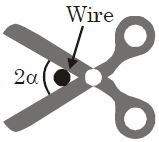
Someone is using a scissors to cut a wire of circular cross section and negligible weight. The wire slides in the direction away from the hinge until the angle between the scissors blades becomes $2 \alpha$. The friction coefficient between the blades and the wire, is :-
Two particles are simultaneously projected in opposite directions horizontally from a given point in space, where gravity $g$ is uniform. If $u_1$ and $u_2$ be their initial speeds, then the time $t$ after which their velocities are mutually perpendicular is given by
If the collision frequency of hydrogen molecules in a closed chamber at $27^{\circ} \mathrm{C}$ is $\mathrm{Z}$, then the collision frequency of the same system at $127^{\circ} \mathrm{C}$ is :
A particle is moving on a circular path with constant speed $v$. It moves between two points $A$ and $B$. which subtends an angle $60^{\circ}$ at the centre of circle. The magnitude of change in its velocity and change in magnitude of its velocity during motion from $A$ to $B$ are respectively ..........
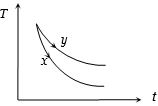
The graph. Shown in the adjacent diagram, represents the variation of temperature $(T)$ of two bodies, $x$ and $y$ having same surface area, with time $(t)$ due to the emission of radiation. Find the correct relation between the emissivity
Two bodies, a ring and a solid cylinder of same material are rolling down without slipping an inclined plane. The radii of the bodies are same. The ratio of velocity of the centre of mass at the bottom of the inclined plane of the ring to that of the cylinder is $\frac{\sqrt{x}}{2}$. Then, the value of $x$ is .... .
A beam of metal supported at the two ends is loaded at the centre. The depression at the centre is proportional to