The internal resistance of a primary cell is $4\, ohm$. It generates a current of $0.2\, amp$ in an external resistance of $21\, ohm$. The rate at which chemical energy is consumed in providing the current is .............. $J/s$
Medium
Download our app for free and get started
(d) $\frac{H}{t} = {i^2}R$. Here total $R = (21 + 4) = 25\,\,\Omega $
$ \Rightarrow $ Rate of energy consumed $ = 0.2 \times 0.2 \times 25$$ = \,1\,\,J/s$
$ \Rightarrow $ Rate of energy consumed $ = 0.2 \times 0.2 \times 25$$ = \,1\,\,J/s$

Download our appand get started for free
Experience the future of education. Simply download our apps or reach out to us for more information. Let's shape the future of learning together!No signup needed.*
Similar Questions
- 1View SolutionLamps used for household lighting are connected in
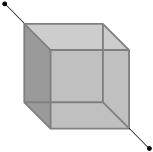
- 2Twelve wires of equal length and same cross-section are connected in the form of a cube. If the resistance of each of the wires is $R$, then the effective resistance between the two diagonal ends would beView Solution
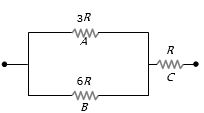
- 3The three resistances $A, B$ and $C$ have values $3R, 6R$ and $R$ respectively. When some potential difference is applied across the network, the thermal powers dissipated by $A, B$ and $C$ are in the ratioView Solution
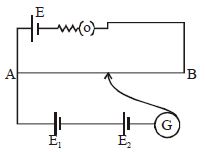
- 4In given arrangement $E_1 = 5\, volts$ $E_2 = 7\, volt$ balancing length is $6\,m$ if terminals of $E_2$ are reversed then new balancing length will beView Solution
- 5A storage battery is connected to a charger for charging with a voltage of $12.5\,\,Volts$. The internal resistance of the storage battery is $1\,\,\Omega$ . When the charging current is $0.5\,\,A$, the emf of the storage battery is: ............... $volts$View Solution
- 6When the current $i$ is flowing through a conductor, the drift velocity is $v$. If $2i$ current is flowed through the same metal but having double the area of cross-section, then the drift velocity will beView Solution
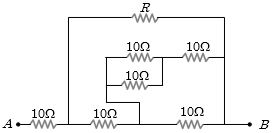
- 7For what value of $R$ the net resistance of the circuit will be $18\, ohms$ ............... $\Omega$View Solution
- 8Different combination of $3$ resistors of equal resistance $R$ are shown in the figures.View Solution
The increasing order for power dissipation is: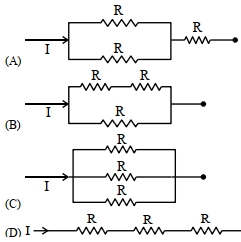
- 9If resistance of the filament increases with temperature, what will be power dissipated in a $220\, V- 100\, W$ lamp when connected to $110\, V$ power supplyView Solution
- 10A battery consists of a variable number '$n$' of identical cells having internal resistances connected in series. The terminals of battery are short circuited and the current $i$ is measured. Which of the graph below shows the relation ship between $i$ and $n$View Solution