Three liquids of equal masses are taken in three identical cubical vessels $A, B$ and $C .$ Their densities are $\rho_{A}, \rho_{B}$ and $\rho_{C} \cdot$ The force exerted by the liquid on the base of the cubical vessel is
AIIMS 2019, Medium
Download our app for free and get started
The formula for the pressure exerted by the liquid on the base is,
$P=\rho g h$
Rewrite the above equation.
$P=\left(\frac{m}{V}\right) g h$
$P=\left(\frac{m}{A \times h}\right) g h$
$P=\frac{g m}{A}$
The force exerted by the liquid is,
$F=P \times A$
$F=\left(\frac{g m}{A}\right) \times A$
$F=g m$
since the mass of the $A, B$ and $C$ are equal.
Therefore, $F_{A}=F_{B}=F_{C}$

Download our appand get started for free
Experience the future of education. Simply download our apps or reach out to us for more information. Let's shape the future of learning together!No signup needed.*
Similar Questions
- 1A cylindrical vessel open at the top is $20$ $cm $ high and $10$ $cm$ in diameter. A circular hole whose cross-sectional area $1$ $cm^2$ is cut at the centre of the bottom of the vessel. Water flows from a tube above it into the vessel at the rate $100$ $cm^3$ $s^{^{-1}}$. The height of water in the vessel under steady state is ....... $cm$ (Take $g$ $=$ $1000 $ $cm s^{^{-2}})$View Solution
- 2A bubble of radius $R$ in water of density $\rho$ is expanding uniformly at speed $v$. Given that water is incompressible, the kinetic energy of water being pushed isView Solution
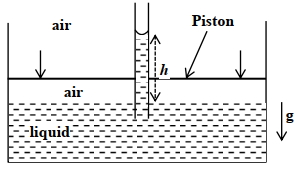
- 3An incompressible liquid is kept in a container having a weightless piston with a hole. A capillary tube of inner radius $0.1 \mathrm{~mm}$ is dipped vertically into the liquid through the airtight piston hole, as shown in the figure. The air in the container is isothermally compressed from its original volume $V_0$ to $\frac{100}{101} V_0$ with the movable piston. Considering air as an ideal gas, the height $(h)$ of the liquid column in the capillary above the liquid level in $\mathrm{cm}$ is. . . . . . .View Solution
[Given: Surface tension of the liquid is $0.075 \mathrm{Nm}^{-1}$, atmospheric pressure is $10^5 \mathrm{~N} \mathrm{~m}^{-2}$, acceleration due to gravity $(g)$ is $10 \mathrm{~m} \mathrm{~s}^{-2}$, density of the liquid is $10^3 \mathrm{~kg} \mathrm{~m}^{-3}$ and contact angle of capillary surface with the liquid is zero]
- 4A train with cross-sectional area $S _{ t }$ is moving with speed $v_t$ inside a long tunnel of cross-sectional area $S _0\left( S _0=4 S _{ t }\right)$. Assume that almost all the air (density $\rho$ ) in front of the train flows back between its sides and the walls of the tunnel. Also, the air flow with respect to the train is steady and laminar. Take the ambient pressure and that inside the train to be $p _0$. If the pressure in the region between the sides of the train and the tunnel walls is $p$, then $p _0- p =\frac{7}{2 N } \rho v_{ t }^2$. The value of $N$ is. . . . .View Solution
- 5View SolutionThe displacement of a ball falling from rest in a viscous medium is platted against time. Choose a possible option
- 6View SolutionIn the case of a fluid, Bernoulli's theorem expresses the application of the principle of conservation of :
- 7A river $10\,m$ deep is flowing at $5\,m/s$. The shearing stress between horizontal layers of the river is :- $(\eta = 10^{-3}\,SI\,unit)$View Solution
- 8View SolutionA boy carries a fish in one hand and a bucket(not full) of water in the other hand . If he places the fish in the bucket , the weight now carried by him (assume that water does not spill) :
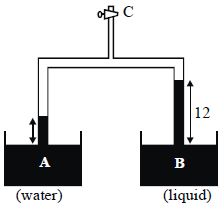
- 9The limbs of a $U$ -tube glass are lowered into vessels $A$ and $B, A$ containing water. Some air is pumped out through the top of the tube $C$. The liquids in the left hand limb $A$ and the right hand limb $B$ rise to heights of $10\, cm$ and $12\, cm$ respectively. The density of liquid $B$ is ........ $g/cm^3$View Solution
- 10There is a hole of area $A$ at the bottom of cylindrical vessel. Water is filled up to a height $ h$ and water flows out in $ t $ second. If water is filled to a height $4h,$ it will flow out in time equal toView Solution