Question
In electromagnetic induction, the induced $e.m.f$. in a coil is independent of

Answer

(c)Because induced $e.m.f.$ is given by $E = - N\frac{{d\varphi }}{{dt}}.$

Need a full question paper?

Generate a complete, print-ready paper with questions like this in minutes — across 16+ boards, with answer keys.
Start Generating Free

Similar questions

Two simple pendulums of length $1\, m$ and $4\, m$ respectively are both given small displacement in the same direction at the same instant. They will be again in phase after the shorter pendulum has completed number of oscillations equal to
The de-Broglie wavelength $\lambda $ associated with an electron having kinetic energy $E$ is given by the expression
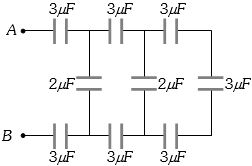
The resultant capacitance between $A$ and $B$ in the following figure is equal to.....$\mu F$
If two moles of diatomic gas and one mole of mono atomic gas are mixed then the ratio of specific heats is
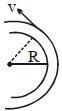
A modern grand-prix racing car of mass $m$ is travelling on a flat track in a circular arc of radius $R$ with a speed $v$. If the coefficient of static friction between the tyres and the track is $\mu_{s},$ then the magnitude of negative lift $F_{L}$ acting downwards on the car is

(Assume forces on the four tyres are identical and $g =$ acceleration due to gravity)
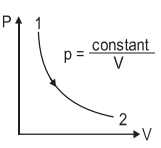
Consider p-V diagram for an ideal gas shown in figure.
Image
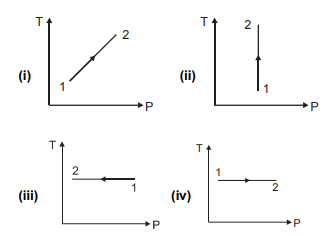
Out of the following diagrams, which figure represents the T-P diagram ?
Image
A particle is whirled in a vertical circle of radius $1.0\  m$ using a string with one end fixed. If the ratio of maximum and minimum tension in the string is $\frac{5}{3}$, the minimum velocity of the particle during circular motion is    ......... $ms^{-1}$
The ionization energy of the electron in the hydrogen atom in its ground state is $13.6\,\, eV.$ The atoms are excited to higher energy levels to emit radiations of $6$ wavelengths . Maximum wavelength of emitted radiation corresponds to the transition between
Three resistances $4\,\Omega $ each of are connected in the form of an equilateral triangle. The effective resistance between two corners is
A charge of $8\; mC$ is located at the origin. Calculate the work done in $J$ in taking a small charge of $-2 \times 10^{-9} \;C$ from a point $P (0,0,3\; cm )$ to a point $Q (0,4\; cm , 0),$ via a point $R (0,6\; cm , g \;cm )$