MCQ
In electromagnetic spectrum, the component whose wavelength is minimum is:
  • Gamma rays
  • B
    X-rays
  • C
    Radio waves
  • D
    Micro waves

Answer

Correct option: A.
Gamma rays
(a)Gamma rays

Need a full question paper?

Generate a complete, print-ready paper with questions like this in minutes — across 16+ boards, with answer keys.

Start Generating Free

Similar questions

For a nucleus ${ }_Z^A X$ having mass number $A$ and atomic number $Z$

$A.$ The surface energy per nucleon $\left(b_s\right)=a_1 A^{2 / 3}$

$B.$ The Coulomb contribution to the binding energy $b_c=-a_2 \frac{Z(Z-1)}{A^{4 / 3}}$

$C.$ The volume energy $b_v=a_3 A$

$D.$ Decrease in the binding energy is proportional to surface area.

$E.$ While estimating the surface energy, it is assumed that each nucleon interacts with $12$ nucleons, $\left(a_1, a_2\right.$ and $a _3$ are constants)

Choose the most appropriate answer from the options given below:
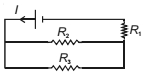
Refer to the circuit shown. What will be the total power dissipation in the circuit if $P$ is the power dissipated in $R_1$ ? It is given that $R_2=4 R_1$ and $R_3=12 R_1$ are .......... $P$
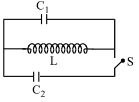
At a moment $(t = 0)$ when charge on capacitor $C_1$ is zero, the switch is closed. If $I_0$ be the current through inductor at that instant, for $t > 0,$
Which is not true with respect to the cathode rays
In a semiconducting material the mobilities of electrons and holes are $\mu$$e$ and $\mu$$h$ respectively. Which of the following is true
Einstein was awarded a Noble Prize for:
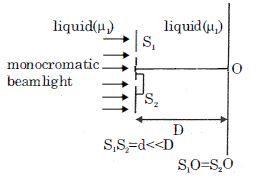
Young's double slit experiment is conducted in a liquid of refractive index $\mu _1$ as show in figure.A thin transprent slab of refractive index $\mu_2$ and thickness $t$ is placed in front of the slit $s_2$.The magnitude of optical path difference at $'O'$ is
$A$ copper rod $AB$ of length $L$, pivoted at one end $A$, rotates at constant angular velocity $\omega$ , at right angles to $a$ uniform magnetic field of induction $B$. The $e.m.f$ developed between the mid point $C$ of the rod and end $B$ is
To make P type semiconductor in silicon :
The chromatic Aberration in lenses becomes due to