Question
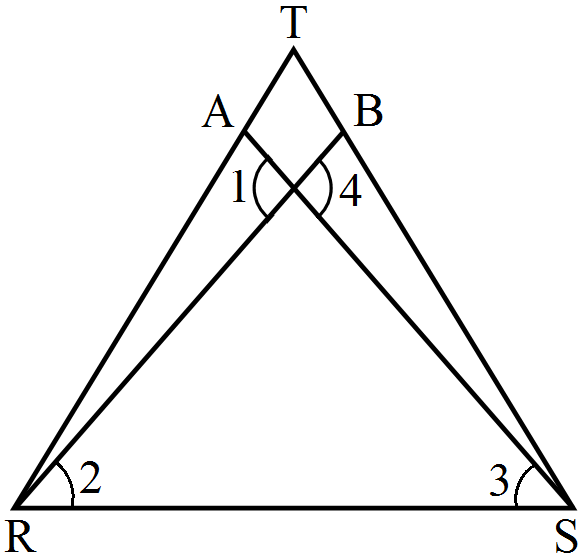
In Fig. it is given that $\text{RT}=\text{TS},\angle1=2\angle2$ and $\angle4=2\angle3.$ prove that $\triangle\text{RBT}\cong\triangle\text{SAT}.$
Answer

Here, $\angle1=2\angle2$ and $\angle4=2\angle3$
$\big[\therefore$ Exterior angle = sum of opposite interior angles $\big]$
$\angle1=\angle4$ [vertically opposite angle] $\therefore2\angle2=2\angle3$
$\Rightarrow\angle2=\angle3$ Now $\text{RT}=\text{TS}$ [given]
$\Rightarrow\angle\text{TRS}=\angle\text{TSR}$
[Angle opposite to equal sides are equal]
$\therefore\angle\text{TRS}-\angle2=\angle\text{TSR}-\angle3$
$\Rightarrow\angle\text{TRB}=\angle\text{TSA}$
Now in $\triangle\text{RBT}$ and $\triangle\text{SAT}$
$\angle\text{T}=\angle\text{T}$ [common]
$\angle\text{TRB}=\angle\text{TSA}$ [proved earlier]
$\text{RT}=\text{TS}$ [given]
By $ASA$ conguence criterion
$\triangle\text{RBT}\cong\triangle\text{SAT}$

Need a full question paper?

Generate a complete, print-ready paper with questions like this in minutes — across 16+ boards, with answer keys.
Start Generating Free

Similar questions

If ABCD is a rhombus with $\angle\text{ABC}=56^\circ,$ find the measure of $\angle\text{ACD}.$
Draw the frequency polygon representing the above data without drawing the histogram.
$ABC$ is a triangle in which $BE$ and $CF$ are, respectively, the perpendiculals to the side $AC$ and $AB$. if $\text{BE}=\text{CF},$ prove that $\triangle\text{ABC}$ is isosceles.
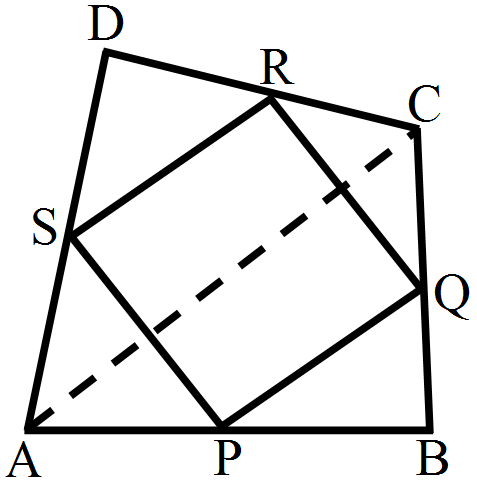
$P , Q, R$ and $S$ are respectively the midpoints of the sides $AB, BC, CD$ and $DA$ of a quadrilateral $\text{ABCD}$. Show that:
$i. PQ \| AC$ and $\text{PQ}=\frac{1}{2}\text{AC}$
$ii. PQ \| SR$
$iii. \text{PQRS}$ is a parallelogram.
The curved surface area of a cylinder is $4400\ cm^2$ and the circumference of its base is $110\ cm$ . Find the height and the volume of the cylinder.
Plot the following points on the graph paper$:(-3, 2)$
Find the volume, the lateral surface area and the total surface area of the cuboid whose dimensions are: Length $= 12cm,$ breadth $= 8\ cm$ and height $= 4.5\ cm$
A circular park of radius 40m is situated in a colony. Three boys Ankur, Amit and Anand are sitting at equal distance on its boundary each having a toy telephone in his hands to talk to each other. Find the length of the string of each phone.
The base $BC$ of $\triangle\text{ABC}$ is divided at $D$ such that $\text{BD}=\frac{1}{2}\text{DC}.$ Prove that $\text{ar}(\triangle\text{ABD})=\frac{1}{3}\times\text{ar}(\triangle\text{ABC}).$