MCQ
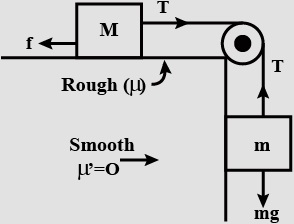
In figure, two blocks $M$ and $m$ are tied together with an inextensible and light string. The mass $M$ is placed on a rough horizontal surface with coefficient of friction $\mu$ and the mass $m$ is hanging vertically against a smooth vertical wall. The pulley is frictionless. Choose the correct statement $(s)$
  • A
    The system will accelerate for any value of $m$
  • B
    The system will accelerate only when $m > M$
  • The system will accelerate only when $m > \mu M$
  • D
    Nothing can be said

Answer

Correct option: C.
The system will accelerate only when $m > \mu M$
c
The friction force on the mass $M$ due to rough surface is $f=\mu M g$

 In equilibrium,

For mass $m$

$T=m g$

for mass $M$

 $f=\mu M g=T \Rightarrow$

$m g=\mu M g \Rightarrow m=\mu M$

If $m g>\mu M g,$ then there would be an acceleration.

Thus, we get $m>\mu M$

Need a full question paper?

Generate a complete, print-ready paper with questions like this in minutes — across 16+ boards, with answer keys.

Start Generating Free

Similar questions

Error in the measurement of radius of a sphere is $1\%$. The error in the calculated value of its volume is  ......... $\%$
In $S = a + bt + c{t^2}$. $S$ is measured in metres and $t$ in seconds. The unit of $c$ is
At a power station, heat is removed from the heat exchanger by cooling water at $6.7 × 10^9\ J$ per minute. The cooling water enters at $6.0\ ^oC$ and leaves at $14.0\ ^oC$ . [Take the specific heat capacity of water $4200\ J/kg^oC$ ] Which of the following is the rate of water flow?
A constant force acting on a body of mass of $5\,kg$ changes its speed from $5\,ms^{-1}$ to $10\,ms^{-1}$ in $10\,s$ without changing the direction of motion. The force acting on the body is  ......... $N$
Two bodies are in equilibrium when suspended in water from the arms of a balance. The mass of one body is $36 g $ and its density is $9 g / cm^3$. If the mass of the other is $48 g$, its density in $g / cm^3$ is
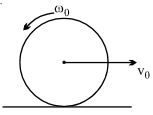
$A$ uniform circular disc placed on $a$ rough horizontal surface has initially a velocity $v_0$ and an angular velocity $\omega_0$ as shown in the figure. The disc comes to rest after moving some distance in the direction of motion. Then $\frac{{{v_0}}}{{r{\omega _0}}}$ is
A tank with a square base of area $2.0 m^2$ is divided into two compartments by a vertical partition in the middle. There is a small hinged door of face area $20 cm^2$ at the bottom of the partition. Water is filled in one compartment and acid, of relative density 1.7 , in the other, both to a height of 4 m . If $g =10 ms^{-2}$ the force necessary to keep the door closed is:
Assume that a drop of liquid evaporates by decrease in its surface energy, so that its temperature remains unchanged. What should be the minimum radius of the drop for this to be possible? The surface tension is $T$, density of liquid is $\rho$ and $L$ is its latent heat of vaporization
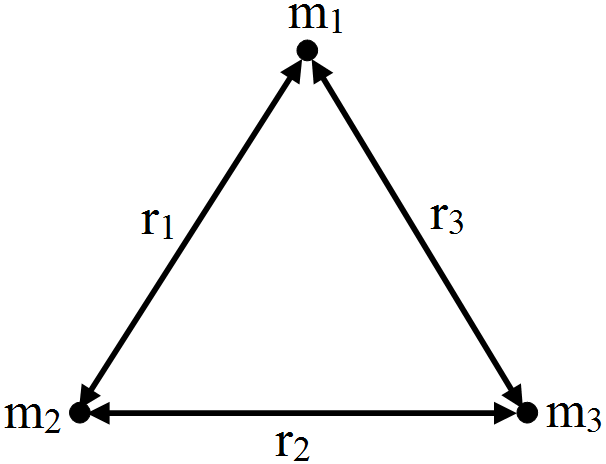
Gravitational potential energy of a system of particles as shown in the figure is:
Three uniform similar rods of length $L$ are joined to form an equilateral triangle then  radius of gyration about an axis passing through one corner and perpendicular to plane  is:-