MCQ
In Gallilean telescope, the final image formed is
  • A
    Real, erect and enlarged
  • Virtual, erect and enlarged
  • C
    Real, inverted and enlarged
  • D
    Virtual, inverted and enlarged

Answer

Correct option: B.
Virtual, erect and enlarged
b
( b)

Need a full question paper?

Generate a complete, print-ready paper with questions like this in minutes — across 16+ boards, with answer keys.
Start Generating Free

Similar questions

A particle revolves with constant angular acceleration $\pi\, rad/s^2$. If the particle starts from rest, how many revolution will it make in the first $10\, seconds$ ?
A force $\overrightarrow{ F }=3 \hat{ i }+2 \hat{ j }+a \hat{k}$ acting on a particle causes a displacement $\vec{s}=\hat{i}+\hat{j}-2 \hat{k}$ in its own direction. If the work done is 11 J, then the value of a will be
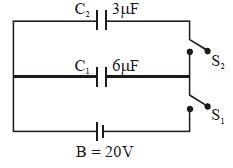
In the circuit shown here $C_1 = 6\,\mu F, C_2 = 3 \,\mu F$ and battery $B = 20\,V$. The switch $S_1$ is first closed. It is then opened and afterwards $S_2$ is closed. What is the charge (in $\mu F$)finally on $C_2$ ?
Two trains $A$ and $B$ are running in the same direction on parallel rails such that $A$ is faster than $B$ . Packets of equal weight are transferred between them. What will happen due to this
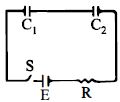
In the following circuit, the switch $S$  is closed at $t = 0.$  The charge on the capacitor  $C_1$  as a function of time will be given by $\left( {{C_{eq}}\, = {\kern 1pt} \,\frac{{{C_1}{C_2}}}{{{C_1} + {C_2}}}} \right).$
The $ P.E.$ of a particle executing $SHM$ at a distance $x$ from its equilibrium position is
Amplitude of a mass-spring system, which is executing simple harmonic motion decreases with time. If mass $=500\, g$, Decay constant $=20 \,g / s$ then ...... $s$ time is required for the amplitude of the system to drop to half of its initial value ? $(\ln 2=0.693)$
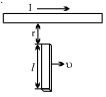
$A$ conducting rod of length $l$ moves with velocity $\upsilon$ a direction parallel to a long wire carrying a steady current $I$. The axis of the rod is maintained perpendicular to the wire with near end $a$ distance $r$ away as shown in the fig. Find the emf induced in the rod.
Four rods of identical cross-sectional area and made from the same metal form the sides of square. The temperature of two diagonally opposite points and $T$ and $\sqrt 2 $ $T$ respective in the steady state. Assuming that only heat conduction takes place, what will be the temperature difference between other two points
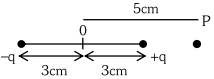
An electric dipole is placed as shown in the figure.The electric potential (in $10^2\,V$ ) at point $P$ due to the dipole is $\left(\epsilon_0=\right.$ permittivity of free space and $\left.\frac{1}{4 \pi \epsilon_0}=K\right)$ :