The $ P.E.$ of a particle executing $SHM$ at a distance $x$ from its equilibrium position is
Easy
Download our app for free and get started
We know that potential energy is given by,
$PE =\frac{1}{2} kx ^2$
and we know, $\omega^2=\frac{k}{m}$
or, $k =\omega^2 m$
Using value of $k$ in equation $(1)$,
$PE =\frac{1}{2} m \omega^2 x ^2$ is our required answer.

Download our appand get started for free
Experience the future of education. Simply download our apps or reach out to us for more information. Let's shape the future of learning together!No signup needed.*
Similar Questions
- 1The equation of an $S.H.M.$ with amplitude $A$ and angular frequency $\omega$ in which all the distances are measured from one extreme position and time is taken to be zero at the other extreme position is ...View Solution
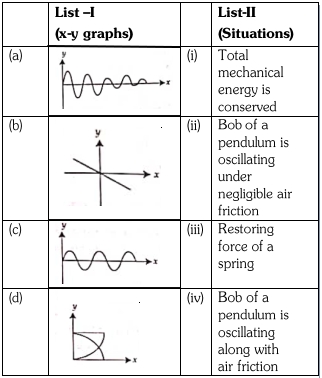
- 2Match $List - I$ with $List - II$View Solution
Choose the correct answer from the options given below
- 3Amplitude of a wave is represented by $A = \frac{c}{{a + b - c}}$ Then resonance will occur whenView Solution
- 4Two simple harmonic motions $y_1 = A \sin \omega t$ and $y_2 =A \cos \omega t$ are superimposed on a particle of mass $m.$ The total mechanical energy of the particle is :View Solution
- 5A mass of $0.2\,kg$ is attached to the lower end of a massless spring of force-constant $200\, N/m,$ the upper end of which is fixed to a rigid support. Which of the following statements is/are true ?View Solution
- 6Two springs have spring constants ${K_A}$ and ${K_B}$ and ${K_A} > {K_B}$. The work required to stretch them by same extension will beView Solution
- 7The particle executing $SHM$ of amplitude $'a'$ has displacement $-\frac {a}{2}$ at $t = \frac {T}{4}$ and a positive velocity. Find the initial phase of particleView Solution
- 8A block is placed on a horizontal plank. The plank is performing $SHM$ along a vertical line with amplitude of $40\,cm.$ The block just loses contact with the plank when the plank is momentarily at rest. Then :View Solution
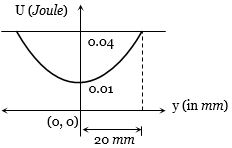
- 9View SolutionThe variation of potential energy of harmonic oscillator is as shown in figure. The spring constant is
- 10A block of mass $1 \,kg$ attached to a spring is made to oscillate with an initial amplitude of $12\, cm$. After $2\, minutes$ the amplitude decreases to $6\, cm$. Determine the value of the damping constant for this motion. (take In $2=0.693$ )View Solution