Two infinitely long parallel wires carry equal current in same direction. The magnetic field at a mid point in between the two wires is
Easy
Download our app for free and get started
(d) At midpoint, magnetic fields due to both the wires are equal and opposite. So $B_{Net}= 0.$

Download our appand get started for free
Experience the future of education. Simply download our apps or reach out to us for more information. Let's shape the future of learning together!No signup needed.*
Similar Questions
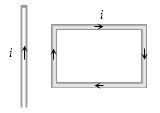
- 1A rectangular loop carrying a current $i$ is situated near a long straight wire such that the wire is parallel to the one of the sides of the loop and is in the plane of the loop. If a steady current $I$ is established in wire as shown in figure, the loop willView Solution
- 2A long solenoid has $n$ turns per meter and current $I\, A$ is flowing through it. The magnetic field at the ends of the solenoid isView Solution
- 3An electron is moving along the positive $X$-axis. You want to apply a magnetic field for a short time so that the electron may reverse its direction and move parallel to the negative $X$-axis. This can be done by applying the magnetic field alongView Solution
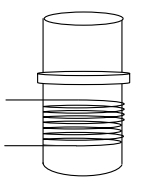
- 4$STATEMENT-1$ A vertical iron rod has a coil of wire wound over it at the bottom end. An alternating current flows in the coil. The rod goes through a conducting ring as shown in the figure. The ring can float at a certain height above the coil. BecauseView Solution
$STATEMENT- 2$ In the above situation, a current is induced in the ring which interacts with the horizontal component of the magnetic field to produce an average force in the upward direction.
- 5View SolutionBohr magneton is given by (symbols have their usual meanings)
- 6A thin rod is bent in the shape of a small circle of radius $'r'$. If the charge per unit length of the rod is $'\sigma ',$ and if the circle is rotated about its axis at the rate of $'n'$ rotation per second, the magnetic induction at a point on the axis at a large distance $'y'$ from the centre isView Solution
- 7View SolutionA charged particle enters a uniform magnetic field perpendicular to it. The magnetic field
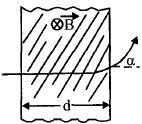
- 8A proton (mass $m$ ) accelerated by a potential difference $V$ flies through a uniform transverse magnetic field $B.$ The field occupies a region of space by width $'d'$. If $\alpha $ be the angle of deviation of proton from initial direction of motion (see figure), the value of $sin\,\alpha $ will beView Solution
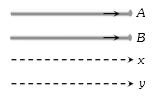
- 9$A$ and $B$ are two conductors carrying a current $i$ in the same direction. $x$ and $y$ are two electron beams moving in the same directionView Solution
- 10A metallic rod of mass per unit length $0.5\; kg\; m^{-1}$ is lying horizontally on a smooth inclined plane which makes an angle of $30^o$ with the horizontal. The rod is not allowed to slide down by flowing a current through it when a magnetic field of induction $0.25\; T$ is acting on it in the vertical direction. The current flowing in the rod to keep it stationary is.....$A$View Solution