Question
In helium nucleus, there are(a) 2 protons and 2 electrons(b) 2 neutrons, 2 protons and 2 electrons(c) 2 protons and 2 neutrons(d) 2 positrons and 2 protons


Answer

(c) 2 protons and 2 neutrons

Need a full question paper?

Generate a complete, print-ready paper with questions like this in minutes — across 16+ boards, with answer keys.
Start Generating Free

Similar questions

A raindrop falls near the surface of the earth with almost uniform velocity because:
  1. Its weight is negligible.
  2. The force of surface tension balances its weight.
  3. The force of viscosity of air balances its weight.
  4. The drops are charged and atmospheric electric field balances its weight.
what is the potential difference between two points, if 2J of work must be done to move a 4 mC charge from one point to another is:
In Young's double slit experiment, the distance between sources is 1 mm and distance between the screen and source is 1 m. If the fringe width on the screen is 0.06 cm, then λ =    (a) 6000 Å(b) 4000 Å(c) 1200 Å(d) 2400 Å
       
The focal length of the objective lens of a compound microscope is(a) Equal to the focal length of its eye piece (b) Less than the focal length of eye piece (c) Greater than the focal length of eye piece (d) Any of the above three 


The earth's magnetic field at a certain place has a horizontal component $0.3$ Gauss and the total strength $0.5$ Gauss. The angle of dip is
The permeability of a paramagnetic substance is:
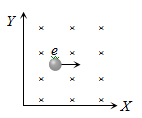
In the given figure, the electron enters into the magnetic field. It deflects in$ ...... $direction
When the light source is moving away, the Doppler effect for light is known as:
Consider a sample of a pure beta-active material:
  1. All the beta particles emitted have the same energy.
  2. The beta particles originally exist inside the nucleus and are ejected at the time of beta decay.
  3. The antineutrino emitted in a beta decay has zero mass and hence zero momentum.
  4. The active nucleus changes to one of its isobars after the beta decay.
Three unequal resistors in parallel are equivalent to a resistance 1 ohm.  If two of them are in the ratio 1 : 2 and if no resistance value is fractional, the largest of the three resistances in ohms is(a) 4(b) 6(c) 8(d) 12