Question
The permeability of a paramagnetic substance is:

Answer

  1. Small but more than unity

Need a full question paper?

Generate a complete, print-ready paper with questions like this in minutes — across 16+ boards, with answer keys.
Start Generating Free

Similar questions

A dip circle is so set that its needle moves freely in the magnetic meridian. In this position, the angle of dip is 40º. Now the dip circle is rotated so that the plane in which the needle moves makes an angle of 30º with the magnetic meridian. In this position, the needle will dip by an angle:
The focal length of a converging lens are $f_v$ and $f_r$ for violet and red light respectively$:$
An LR circuit with a battery is connected at t = 0. Which of the following quantities is not zero just after the connection?
  1. Current in the circuit.
  2. Magnetic field energy in the inductor.
  3. Power delivered by the battery.
  4. Emf induced in the inductor.
Excitation energy of a hydrogen like ion in its first excitation state is 40.8 eV. Energy needed to remove the electron from the ion in ground state is(a) 54.4 eV(b) 13.6 eV(c) 40.8 eV(d) 27.2 eV
       
Which of the following rays are not electromagnetic waves(a) g-rays (b) b-rays(c) Heat rays(d) X-rays
       
Two concentric coils each of radius equal to $2\pi \ cm$ are placed at right angles to each other. $3$ ampere and $4$ ampere are the currents flowing in each coil respectively. The magnetic induction in  $\ce{Weber/m^2}$  at the centre of the coils will be $\left({\mu_0}=4 \pi \times 10^{-7} wb / A . m\right)$
The area of the plates of a parallel plate condenser is $A$ and the distance between the plates is $10\ mm$. There are two dielectric sheets in it, one of dielectric constant $10$ and thickness $6\ mm$ and the other of dielectric constant $5$ and thickness $4\ mm$. The capacity of the condenser is
Temperature coefficient of resistance of semiconductor is:
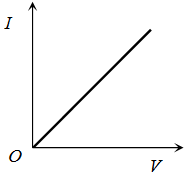
$I-V$ characteristic of a copper wire of length $L$ and area of cross$-$section $A$ is shown in figure.  The slope of the curve becomes
The curve between current $(i)$ and potential difference $(V)$ for a photo cell will be