Question
In how many ways the continuous charges are distributed?

Answer

►There are three types of continuous electric charge distribution.
(1) Linear distribution.
(2) Surface distribution.
(3) Volume distribution.

Need a full question paper?

Generate a complete, print-ready paper with questions like this in minutes — across 16+ boards, with answer keys.
Start Generating Free

Similar questions

Define electric field strength. Is it a vector or a scalar quantity?
A straight solenoid of length $50 \ cm$ has $1000$ turns and a mean cross$-$sectional area of $2 \times 10^{-4} m^2$. It is placed with its axis at $30^{\circ}$, with a uniform magnetic field of $0.32 T .$ Find the torque acting on the solenoid when a current of $2 A$ is passed through it.
Prove that the electric field at the surface of a charged conductor is $\overrightarrow{ E }=\frac{\sigma}{\varepsilon_0} \hat{n}$. Where, $\sigma$ - Surface charge density, $\hat{n}$ - unit vector normal to the surface and in going outward direction.
If a constant potential difference is applied across a bulb, the current slightly decreases as time passes and then becomes constant. Explain.
The force on a north pole,$\overrightarrow{\text{F}}=\text{m}\overrightarrow{\text{B}},$ is parallel to the field $\overrightarrow{\text{B}}.$ Does it contradict our earlier knowledge that a magnetic field can exert forces only perpendicular to itself?
A wire is bent in the form of a regular hexagon and a total charge q is distributed uniformly on it. What is the electric field at the centre? You may answer this part without making any numerical calculations.
A charged particle oscillates about its mean (equilibrium) position with a frequency of $10^9Hz.$ What is the frequency of the electromagnetic waves produced by the oscillator?
Explain how the width of depletion layer in a p-n junction diode changes when the junction is (i) forward biased (ii) reverse biased.
Using the formula for the radius of $n ^{\text {th }}$ orbit $r_n=\frac{n^2 h^2 \varepsilon_0}{\pi m e^2}$ derive an expression for the total energy of electron in $n^{\text {th }}$ Bohr's orbit.
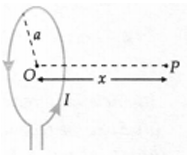
A student records the following data for the magnitudes $(B)$ of the magnetic field at axial points at different distances $x$ from the centre of a circular coil of radius a carrying a current $I.$ Verify $($for any two$)$ that these observations are in good agreement with the expected theoretical variation of $B$ with $x.$
Image
$x \rightarrow$ $x = 0$ $x - a$ $x = 2 a$ $x = 3a$
$y \rightarrow$ $B _0$ $0.25 \sqrt{2} B_0$ $0.039 \sqrt{5} B_0$ $0.010 \sqrt{10} B_0$