MCQ
In insulator:
  • A
    Valence band is partially filled with electrons.
  • B
    Conduction band is partially filled with electrons.
  • C
    Conduction band is filled with electrons and valence band is empty.
  • D
    Conduction band is empty and valence band is filled with electrons.

Answer

  1. Conduction band is empty and valence band is filled with electrons.

Explanation:

Insulators are the materials which do not conduct electricity. All the electrons are filled in valance band whereas the conduction band is empty. Moreover, the energy band gap in insulators is very large, thus electrons cannot jump from valence band to conduction band.

Need a full question paper?

Generate a complete, print-ready paper with questions like this in minutes — across 16+ boards, with answer keys.

Start Generating Free

Similar questions

Identify which of the following color light, when passed through a double-slit opening, will produce the widest central band of light on the screen?

In Young's double slit experiment, the distance between sources is 1 mm and distance between the screen and source is 1 m. If the fringe width on the screen is 0.06 cm, then λ =    

(a) 6000 Å

(b) 4000 Å

(c) 1200 Å

(d) 2400 Å

What is the de-Broglie wavelength of the α - particle accelerated through a potential difference V

(a)  Å

(b) Å

(c) Å

(d) Å

Fusion reaction takes place at very high temperature because:

Magnetic moments of two bar magnets may be compared with the help of

(a)  Deflection magnetometer

(b) Vibration magnetometer

(c) Both of the above

(d) None of the above

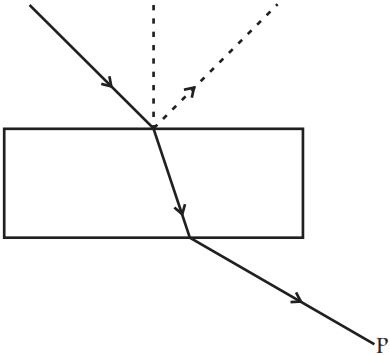
Consider a light beam incident from air to a glass slab at Brewster's angle as shown in Fig. A polaroid is placed in the path of the emergent ray at point P and rotated about an axis passing through the centre and perpendicular to the plane of the polaroid.

The equation of a light wave is written as $\text{y}=\text{A}\ \sin(\kappa\text{x}-\omega\text{t}).$ Here, y represents:

A ray of light is incident at an angle i from denser to rare medium. The reflected and the refracted rays are mutually perpendicular. The angle of reflection and the angle of refraction are respectively r and r’, then the critical angle will be

(a)

(b)

(c)

(d)

A body can be negatively charged by

(a) Giving excess of electrons to it

(b) Removing some electrons from it

(c) Giving some protons to it

(d) Removing some neutrons from it

A long solenoid carrying a current produces a magnetic field B along its axis. If the current is doubled and the number of turns per cm is halved, the new value of the magnetic field is

(a) B

(b) 2 B

(c) 4 B      

(d) B/2