MCQ
In LCR series AC circuit.
- AIf R is increased current will decrease.
- BIf L is increased current will decrease.
- CIf C is increased current will increase.
- DIf C is increased current will decrease.
Explanation:
$\text{I}=\frac{\text{V}}{\text{Z}}=\frac{\text{V}}{\sqrt{\text{R}^2\Big(\omega\text{L }\sim}\frac{1}{\omega\text{C}}\Big)^2}$
By increasing R, current will definitely decrease by change in L or C, current may increase or decrease.
Generate a complete, print-ready paper with questions like this in minutes — across 16+ boards, with answer keys.
When  electrons are removed from a neutral metal plate, the electric charge on it is
|
(a) – 1.6 C |
(b) + 1.6 C |
(c) 10 +19 C |
(d) 10–19 C |
The resistance of an incandescent lamp is
|
(a) Greater when switched off |
|
(b) Smaller when switched on |
|
(c) Greater when switched on |
|
(d) The same whether it is switched off or switched on |
Total internal reflection of a ray of light is possible when the ( = critical angle, i = angle of incidence)
|
(a) Ray goes from denser medium to rarer medium and |
|
(b) Ray goes from denser medium to rarer medium and |
|
(c) Ray goes from rarer medium to denser medium and |
|
(d) Ray goes from rarer medium to denser medium and |
In the forward bias arrangement of a PN-junction diode
|
(a) The N-end is connected to the positive terminal of the battery |
|
(b) The P-end is connected to the positive terminal of the battery |
|
(c) The direction of current is from N-end to P-end in the diode |
|
(d) The P-end is connected to the negative terminal of battery |
If  is 6563 Å, then wave length of second line for Balmer series will be
|
(a) |
(b) |
(c) |
(d) None of the above |
In the circuit shown below the resistance of the galvanometer is 20 W. In which case of the following alternatives are the currents arranged strictly in the decreasing order
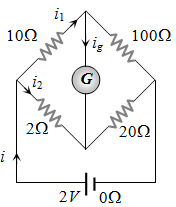
|
(a) i, i1, i2, ig |
(b) i, i2, i1, ig |
(c) i, i2, ig, i1 |
(d) i, i1, ig, i2 |


