In making an alloy, a substance of specific gravity ${s_1}$ and mass ${m_1}$ is mixed with another substance of specific gravity ${s_2}$ and mass ${m_2}$; then the specific gravity of the alloy is
Medium


Download our appand get started for free
Experience the future of education. Simply download our apps or reach out to us for more information. Let's shape the future of learning together!No signup needed.*
Similar Questions
- 1A flat plate of area $10\,cm^2$ is separated from a large plate by a layer of glycerine $1\, mm$ thick. If the coefficient of viscosity of glycerine is $20$ poise, the force required to keep the plate moving with a velocity of $1\,cm/sec$ is .......... $dyne$View Solution
- 2An air bubble of $1\, cm$ radius is rising at a steady rate of $2.00\, mm/sec$ through a liquid of density $1.5\, gm$ per $cm^3$. Neglect density of air. If $g$ is $1000\, cm/sec^2$, then the coefficient of viscosity of the liquid isView Solution
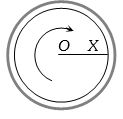
- 3The diagram shows a cup of tea seen from above. The tea has been stirred and is now rotating without turbulence. A graph showing the speed $ v$ with which the liquid is crossing points at a distance $ X$ from $O $ along a radius $XO$ would look likeView Solution
- 4A tank is filled with water of density $1\,g$ per $cm^3$ and oil of density $0.9\,g$ per $cm^3$ . The height of water layer is $100\,cm$ and of the oil layer is $400\,cm.$ If $g = 980\,cm/sec^2,$ then the velocity of efflux from an opening in the bottom of the tank isView Solution
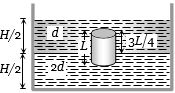
- 5A homogeneous solid cylinder of length $L$$(L < H/2)$. Cross-sectional area $A/5$ is immersed such that it floats with its axis vertical at the liquid-liquid interface with length $L/4$ in the denser liquid as shown in the fig. The lower density liquid is open to atmosphere having pressure ${P_0}$. Then density $D$ of solid is given byView Solution
- 6Two solids $A$ and $ B$ float in water. It is observed that $A$ floats with $\frac{1}{2}$ of its body immersed in water and $ B$ floats with $\frac{1}{4}$ of its volume above the water level. The ratio of the density of $ A$ to that of $B$ isView Solution
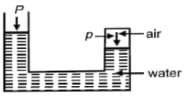
- 7The pressure of confined air is $p$. If the atmospheric pressure is $P$, thenView Solution
- 8View SolutionWith rise in temperature, density of a given body changes according to one of the following relations
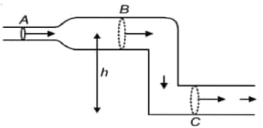
- 9Water is flowing through a channel (lying in a vertical plane) as shown in the figure. Three sections $A, B$ and $C$ are shown. Sections $B$ and $C$ have equal area of cross section. If $P_A, P_B$ and $P_C$ are the pressures at $A, B$ and $C$ respectively thenView Solution
- 10A tank is filled with water of density $1\,g$ per $cm^3$ and oil of density $0.9\,g$ per $cm^3$ . The height of water layer is $100\,cm$ and of the oil layer is $400\,cm.$ If $g = 980\,cm/sec^2,$ then the velocity of efflux from an opening in the bottom of the tank isView Solution