MCQ
In melting lattice, structure of solid
  • A
    Remains unchanged
  • Changes
  • C
    Becomes compact
  • D
    None of the above

Answer

Correct option: B.
Changes
b
In melting lattice, struture of solid changes Because of the repeating geometric structure of the crystal, all the bonds between the particles have equal strength. A crystalline solid will have a distinct melting point, because applying heat will break all the bonds at the same time.

Need a full question paper?

Generate a complete, print-ready paper with questions like this in minutes — across 16+ boards, with answer keys.
Start Generating Free

Similar questions

Select the odd one
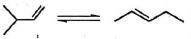
The heat of hydrogenation for $3$ -methylbutene and $2$ -pentene are $-30\, kcal/mol$ and $-28\,kcal/mol$ respectively. The heats of combustion of $2$ -methylbutane and  pentane are - $784 \,kcal / mol$ and $-782 \,kcal/mol$ respectively. All the values are  given under standard conditions. Taking into account that combustion of both alkanes  give the same products, what is $\Delta H$ (in $kcal/mol$) for the following reaction under  same conditions ?
Solubility of $BaF_2$ in a solution of $Ba(NO_3)_2$ will be represented by the concentration term?
Assign $A, B, C, D$ from given type of reaction. $Red\, P + Alkali \longrightarrow Na_4P_2O_6 + P_2H_4$
The strongest acid is
$\mathrm{PCl}_5, \mathrm{PCl}_3$ and $\mathrm{Cl}_2$ are at equilibrium at $500\  K$ in a closed container and their concentrations are $0.8 \times 10^{-3} \mathrm{~mol} \mathrm{~L}^{-1}, 1.2 \times 10^{-3}$ $\mathrm{mol} \mathrm{L}^{-1}$ and $1.2 \times 10^{-3} \mathrm{~mol} \mathrm{~L}^{-1}$ respectively.
The value of $\mathrm{K}_{\mathrm{c}}$ for the reaction $\text{PCl}_5\text{g}\rightleftharpoons\text{PCl}_3\text{(g)}+\text{Cl}_2\text{g}$ will be.
Aluminium is diagonally related to (in periodic table)
$2\,L$ of $0.2\,M H _{2} SO _{4}$ is reacted with $2\,L$ of $0.1\,M$ $NaOH$ solution, the molarity of the resulting product $Na _{2} SO _{4}$ in the solution is millimolar. (Nearest integer).
Which member of $\ce{IIA}$ group shows covalency?
Amongst $LiCl, BeCl_2, MgCl_2$ and $RbCl$ the compounds with greatest and  least ionic character, respectively are