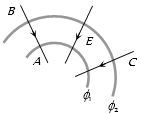
In moving from $A$ to $B$ along an electric field line, the electric field does $6.4 \times {10^{ - 19}}\,J$ of work on an electron. If ${\phi _1},\;{\phi _2}$ are equipotential surfaces, then the potential difference $({V_C} - {V_A})$ is.....$V$
Medium
Download our app for free and get started
(b) Work done by the field $W = q( - dV) = - e({V_A} - {V_B})$
= $e({V_B} - {V_A})$ = $e({V_C} - {V_A})$ $(\because V_B = V_C)$
$==>$ $({V_C} - {V_A})$ $ = \frac{W}{e} = \frac{{6.4 \times {{10}^{ - 19}}}}{{1.6 \times {{10}^{ - 19}}}} = 4\,V$
= $e({V_B} - {V_A})$ = $e({V_C} - {V_A})$ $(\because V_B = V_C)$
$==>$ $({V_C} - {V_A})$ $ = \frac{W}{e} = \frac{{6.4 \times {{10}^{ - 19}}}}{{1.6 \times {{10}^{ - 19}}}} = 4\,V$

Download our appand get started for free
Experience the future of education. Simply download our apps or reach out to us for more information. Let's shape the future of learning together!No signup needed.*
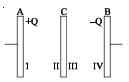
Similar Questions
- 1A condenser of $2\,\mu F$ capacitance is charged steadily from $0$ to $5$ $Coulomb$. Which of the following graphs correctly represents the variation of potential difference across its plates with respect to the charge on the condenserView Solution
- 2Two tiny electric dipoles of dipole moment $P_1$ and $P_2$ are placed $'r'$ distance coaxially find magnitude of electrostatic force between them.View Solution
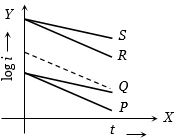
- 3In an $RC$ circuit while charging, the graph of in $i$ versus time is as shown by the dotted line in the diagram figure, where $i$ is the current. When the value of the resistance is doubled, which of the solid curve best represents the variation of in $i$ versus timeView Solution
- 4Three concentric spherical shells have radii $a, b$ and $c (a < b < c)$ and have surface charge densities $\sigma ,-\;\sigma $ and $\;\sigma \;$ respectively. If $V_A,V_B$ and $V_C$ denote the potentials of the three shells, then, for $c = a +b,$ we haveView Solution
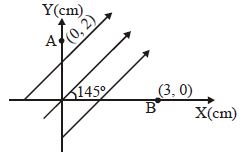
- 5A uniform electric field of $400 \,v/m$ is directed $45^o$ above the $x$ - axis. The potential difference $V_A - V_B$ is -.....$V$View Solution
- 6A parallel plate capacitor carries a charge $q$. The distance between the plates is doubled by application of a force. The work done by the force isView Solution
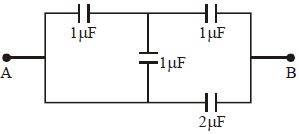
- 7The equivalent capacitance between points $A$ and $B$ of the circuit shown will beView Solution
- 8For equal point charges $Q$ each are placed in the $xy$ plane at $(0, 2), (4, 2), (4, -2)$ and $(0, -2)$. The work required to put a fifth change $Q$ at the origin of the coordinate system will beView Solution
- 9Four equal charges $Q$ are placed at the four corners of a square of each side is $'a'$. Work done in removing a charge $-Q$ from its centre to infinity isView Solution
- 10Plates $A$ and $B$ constitute an isolated, charge parallel-plate capacitor. The inner surfaces ($I$ and $IV$) of $A$ and $B$ have charges $+Q$ and $-Q$ respectively. Athird plate $C$ with charge $+$$Q$ is now introduced midway between $A$ and $B$. Which of the following statements is not correct?View Solution