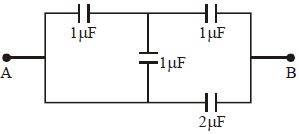
The equivalent capacitance between points $A$ and $B$ of the circuit shown will be
Medium
Download our app for free and get started
Download our app
and get started for free
Experience the future of education. Simply download our apps or reach out to us for more information. Let's shape the future of learning together!No signup needed.*
A charge $Q$ is distributed over three concentric spherical shell of radii $a, b, c (a < b < c)$ such that their surface charge densities are equal to one another. The total potential at a point at distance $r$ from their common centre, where $r < a$, would be
Two capacitors of $3\,pF$ and $6\,pF$ are connected in series and a potential difference of $5000\,V$ is applied across the combination. They are then disconnected and reconnected in parallel. The potential between the plates is
A series combination of three capacitors of capacities $1\,\mu \,F,\,2\,\mu \,F$ and $8\,\mu \,F$ is connected to a battery of $e.m.f.$ $13\, volt$. The potential difference across the plates of $2\,\mu \,F$ capacitor will be.....$V$
$A$ $2$ $\mu F$ capacitor is charged to a potential $=$ $10\,V$. Another $4$ $\mu F$ capacitor is charged to a potential $=$ $20\,V$. The two capacitors are then connected in a single loop, with the positive plate of one connected with negative plate of the other. What heat is evolved in the circuit?......$\mu J$
Two capacitors $C_1$ and $C_2 = 2C_1$ are connected in a circuit with a switch between them as shown in the figure. Initially the switch is open and $C_1$ holds charge $Q$. The switch is closed. At steady state, the charge on each capacitor will be
Three identical small electric dipoles are arranged parallel to each other at equal separation a as shown in the figure. Their total interaction energy is $U$. Now one of the end dipole is gradually reversed, how much work is done by the electric forces.