Question
In n-type of semiconductor, majority carries are:

Answer

  1. Electron
Explanation:
In n-type semiconductor, large number of free electrons is present. Hence, free electrons are the majority charge carriers in the n-type semiconductor. The free electrons (majority charge carriers) carry most of the electric charge or electric current in the n-type semiconductor.

Need a full question paper?

Generate a complete, print-ready paper with questions like this in minutes — across 16+ boards, with answer keys.
Start Generating Free

Similar questions

A wire of length $100 \ cm$ is connected to a cell of emf $2\ V$ and negligible internal resistance.  The resistance of the wire is $3\Omega$.  The additional resistance required to produce a potential drop of $1$ milli volt per cm is
In a Young's double slit experiment, the source is white light. One of the holes is covered by a red filter and another by a blue filter. In this case:
Ultraviolet radiations of $6.2 \ eV$ falls on an aluminium surface $($work function $4.2 \ eV ).$ The kinetic energy in joules of the fastest electron emitted is approximately
Refer to the arrangement of charges in Fig. and a Gaussian surface of radius R with Q at the centre. Then:
A battery having e.m.f. 5V and internal resistance 0.5 W is connected with a resistance of 4.5 W then the voltage at the terminals of battery is(a) 4.5 V(b) 4 V(c) 0 V(d) 2 V
       
In a transistor, a change of 8.0 mA in the emitter current produces a change of 7.8 mA in the collector current. What change in the base current is necessary to produce the same change in the collector current(a) 50 mA(b) 100 mA(c) 150 mA(d) 200 mA
       
Two ions have equal masses but one is singly-ionised and the other is doubly-ionised. They are projected from the same place in a uniform magnetic field with the same velocity perpendicular to the field.
  1. Both ions will move along circles of equal radii.
  2. The circle described by the singly-ionised charge will have a radius that is. double that of the other circle.
  3. The two circles do not touch each other.
  4. The two circles touch each other.
Out of dia, para and ferromagnetism, the universal property of all substances is:
To an observer on the earth the stars appear to twinkle. This can be ascribed to(a) The fact that stars do not emit light continuously(b) Frequent absorption of star light by their own atmosphere(c) Frequent absorption of star light by the earth's atmosphere(d) The refractive index fluctuations in the earth's atmosphere


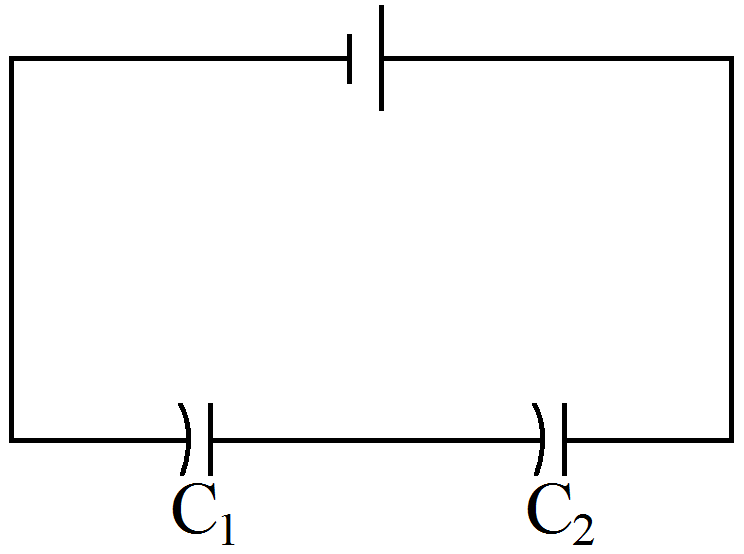
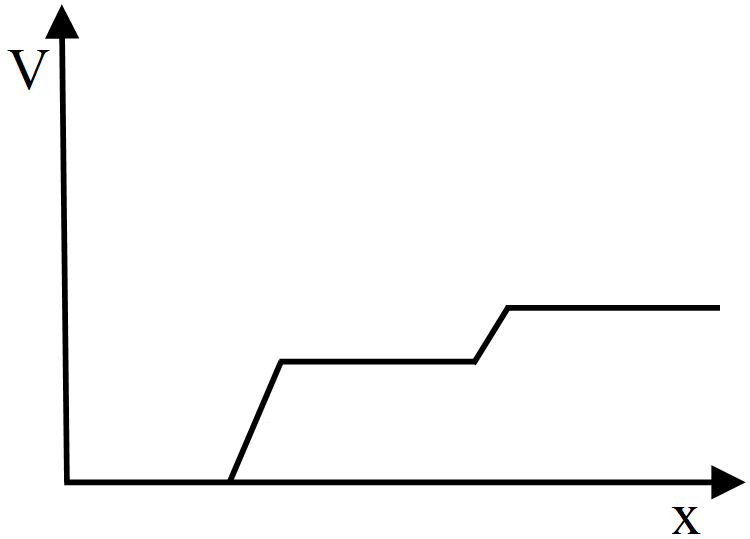
Figure shows two capacitors connected in series and joined to a battery. The graph shows the variation in potential as one moves from left to right on the branch containing the capacitors: