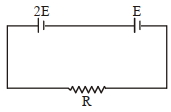
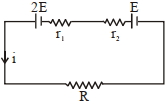
Two cells of emf $2\, E$ and $E$ with internal resistance $r _{1}$ and $r _{2}$ respectively are connected in series to an external resistor $R$ (see $figure$). The value of $R ,$ at which the potential difference across the terminals of the first cell becomes zero is
JEE MAIN 2021, Diffcult


Download our appand get started for free
Experience the future of education. Simply download our apps or reach out to us for more information. Let's shape the future of learning together!No signup needed.*
Similar Questions
- 1If a $0.1\%$ increase in length due to stretching, the percentage increase in its resistance will be ............ $\%$View Solution
- 2View SolutionThe net resistance of a voltmeter should be large to ensure that
- 3A copper wire of length $10\,m$ and radius $\left(10^{-2} / \sqrt{\pi}\right) m$ has electrical resistance of $10 \,\Omega$. The current density in the wire for an electric field strength of $10( V / m )$ is :View Solution
- 4The resistance of a wire is $R$. If the length of the wire is doubled by stretching, then the new resistance will beView Solution
- 5View SolutionElectromotive force is the force, which is able to maintain a constant
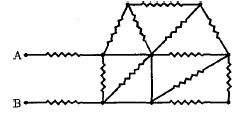
- 6How many $60 \,W$ bulbs may be safely run on $220 \,V$ using a $5 \,A$ fuse is .........View Solution
- 7When a resistor of $11 \,\Omega$ is connected in series with an electric cell, the current flowing in it is $0.5\, A$. Instead, when a resistor of $5 \,\Omega$ is connected to the same electric cell in series, the current increases by $0.4\, A$. The internal resistance of the cell is ................ $\Omega$View Solution
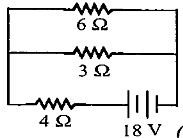
- 8The total power dissipated in watt in the circuit shown here is ............. $W$View Solution
- 9View SolutionIn the circuit as shown in figure the
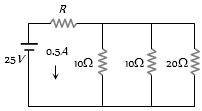
- 10In the given circuit all resistances are of value $R\,ohm$ each. The equivalent resistance between $A$ and $B$ isView Solution