Question
In nuclear reaction  A denotes
|
(a) Electron |
(b) Positron |
(c) Proton |
(d) Neutron |
In nuclear reaction A denotes
|
(a) Electron |
(b) Positron |
(c) Proton |
(d) Neutron |
(d) Neutron
Generate a complete, print-ready paper with questions like this in minutes — across 16+ boards, with answer keys.
If in the circuit shown below, the internal resistance of the battery is 1.5 W and VP and VQ are the potentials at P and Q respectively, what is the potential difference between the points P and Q
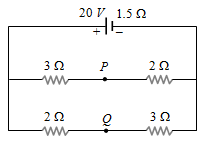
|
(a) Zero |
(b) 4 volts (VP > VQ) |
(c) 4 volts (VQ > VP) |
(d) 2.5 volts (VQ > VP) |
If  millimho, then on increasing plate voltage by 50 V, how much the grid voltage is changed so that plate current remains the same
|
(a) – 2.86 V |
(b) – 4 V |
(c) + 4 V |
(d) + 2 V |
3 identical bulbs are connected in series and these together dissipate a power P. If now the bulbs are connected in parallel, then the power dissipated will be
|
(a) |
(b) 3P |
(c) 9P |
(d) |
Donor type impurity is found in
|
(a) Trivalent elements |
(b) Pentavalent elements |
|
(c) In both the above |
(d) None of these |

