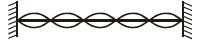
In one metre long open pipe what is the harmonic of resonance obtained with a tuning fork of frequency $480 Hz$
Easy


Download our appand get started for free
Experience the future of education. Simply download our apps or reach out to us for more information. Let's shape the future of learning together!No signup needed.*
Similar Questions
- 1A sound source $S$ is moving along a straight track with speed $v,$ and is emitting sound of frequency $v_{o}$ (see figure). An observer is standing at a finite clistance, at the point $O$, from the track. The time variation of frequency heard by the observer is best represented byView Solution
$\left(t_{0}\right.$ represents the instant when the distance between the source and observer is minimum)
- 2An observer is moving away from source of sound of frequency $100 Hz$. His speed is $33 \,m/s$. If speed of sound is $330 \,m/s$, then the observed frequency is .... $Hz$View Solution
- 3Which of the following is not true for this progressive wave $y = 4\sin 2\pi \left( {\frac{t}{{0.02}} - \frac{x}{{100}}} \right)$ where $y$ and $x$ are in $cm$ & $t$ in $sec$View Solution
- 4A stationary source emits sound of frequency $\mathrm{f}_0=492 \mathrm{~Hz}$. The sound is reflected by a large car approaching the source with a speed of $2 \mathrm{~ms}^{-1}$. The reflected signal is received by the soruce and superposed with the original. What will be the beat frequency of the resulting signal in $\mathrm{Hz}$ ? (Given that the speed of sound in air is $330 \mathrm{~ms}^{-1}$ and the car reflects the sound at the frequency it has received).View Solution
- 5Two engines pass each other moving in opposite directions with uniform speed of $30\,m/s$ . One of them is blowing a whistle of frequency $540\,Hz.$ Calculate the frequency heard by driver of second engine before they pass each other ... $Hz$. Speed of sound is $330\,m/sec$View Solution
- 6A source of frequency $f$ is emitting sound waves. If temperature of the medium increases, thenView Solution
- 7Two sound sources when sounded simultaneously produce four beats in $0.25$ second. the difference in their frequencies must beView Solution
- 8View SolutionThe Doppler's effect is applicable for
- 9View SolutionWhich of the following is not the transverse wave
- 10A string fixed at its both ends vibrates in $5\,\,loops$ as shown in the figureView Solution
The total number of nodes and antinodes are respectively