Question
Read the passage given below and answer the following questions from $1$ to $5$. When an object moves along a straight line with uniform acceleration, it is possible to relate its velocity, acceleration during motion and the distance covered by it in a certain time interval by a set of equations known as the equations of motion. For convenience, a set of three such equations are given below: $v = u + at $$\text{s}=\text{ut}+\frac{1}{2}\text{at}^2$ $2a s = v^2 – u^2$ Where u is the initial velocity of the object which moves with uniform acceleration a for Time $t, v$ is the final velocity and s is the distance travelled by the object in time.
  1. equation of motions are applicable to motion with
  1. uniform acceleration
  2. non uniform acceleration
  3. constant velocity
  4. none of these
  1. There are $4$ equation of motion. True or false?
  1. True
  2. False
  1. The brakes applied to a car produce an acceleration of $10\ m/s^2$​​​​​​​ in the opposite direction to the motion. If the car takes $1\ s$ to stop after the application of brakes, calculate the distance traveled during this time by car.
  1. An object is dropped from a tower falls with a constant acceleration of $10\ m/s2$. Find its speed $10\ s$ after it was dropped.
  1. A bullet hits a Sand box with a velocity of $10\ m/s$ and penetrates it up to a distance of $5\ cm$. Find the deceleration of the bullet in the sand box
Answer

  1. (a) uniform acceleration
  2. (b) False
  3. Here in this problem,
$v = 0$
$a = -10 m/s2$ (as acceleration is retarding)
$t = 1\ sec.$
To find: distance travelled
Solution: using kinematic equation
$v = u + at$
$0= u + -10 \times 1$
$u = 10\ m/s$
Therefore distance is given by
$\text{S}=\text{ut}+\frac{1}{2}\text{at}^2$
$\text{S}=10\times1-\Big(\frac{1}{2}\Big)\times10\times1^2$
$s = 5m$
  1. Here in this problem,
$u = 0$
$a = 10 m/s^2​​​​​​​$​​​​​​​(as acceleration is in the direction of gravity)
$t = 10\ sec$.
To find: final velocity after 10 second
Solution: using kinematic equation
$v = u + at$
$v = 0 + 10 \times 10$
$v = 100 m/s$​​​​​​​
  1. Here in this problem,
$v = 0$(as bullet is going to stop)
$u = 10 m/s$
$s = 5m$.
To find: deceleration of the bullet
Solution: using kinematic equation
$2a s = v^2 – u^2$
$2 \times a \times 5 = 0^2- 10^2$
$10a = -100$
$\text{A}=\frac{100}{10}$
$a = -10m/s^2$. Negative sign indicates that it is deceleration.

Need a full question paper?

Generate a complete, print-ready paper with questions like this in minutes — across 16+ boards, with answer keys.

Start Generating Free

Similar questions

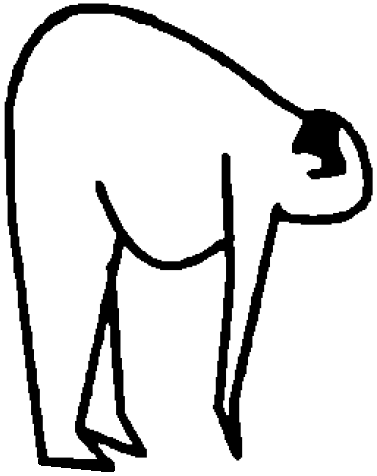
When a fat person tries to touch his toes, keeping the legs straight, he generally falls. Explain with reference to figure.
Read the passage given below and answer the following questions from 1 to 3. Bernoulli's Theorem It states that for the streamline flow of an ideal liquid through a tube, the total energy (the sum of pressure energy, the potential energy and kinetic energy) per unit volume remains constant at every cross-section throughout the tube.$\text{P}+\text{pgh}+\frac{1}{2}\text{pv}^2$ = constant
or $\frac{\text{P}}{\text{pg}}+\text{h}+\frac{1}{2}\frac{\text{v}^2}{\text{g}}$ = another constant Here, $\frac{\text{P}}{\text{pg}}$ = pressure head; h = potential head and $\frac{1}{2}\frac{\text{v}^2}{\text{g}}$ velocity head. If the liquid is flowing through a horizontal tube, then h is constant, then according to Bernoulli’s theorem,$\frac{\text{P}}{\text{pg}}+\frac{1}{2}\frac{\text{v}^2}{\text{g}}$ constant
Bernoulli’s theorem is based on law of conser - vation of energy.
  1. Bernoulli’s equation for steady, non-viscous, incompressible flow expresses the:
  1. Conservation of linear momentum
  2. Conservation of angular momentum
  3. Conservation of energy
  4. Conservation of mass
  1. Applications of Bernoulli’s theorem can be seen in:
  1. Dynamic lift of aeroplane
  2. Hydraulic press
  3. Helicopter
  4. None of these
  1. A tank filled with fresh water has a hole in its bottom and water is flowing out of it. If the size of the hole is increased, then:
  1. The volume of water flowing out per second will decrease.
  2. The velocity of outflow of water remains unchanged.
  3. The volume of water flowing out per second remains zero.
  4. Both (b) and (c)
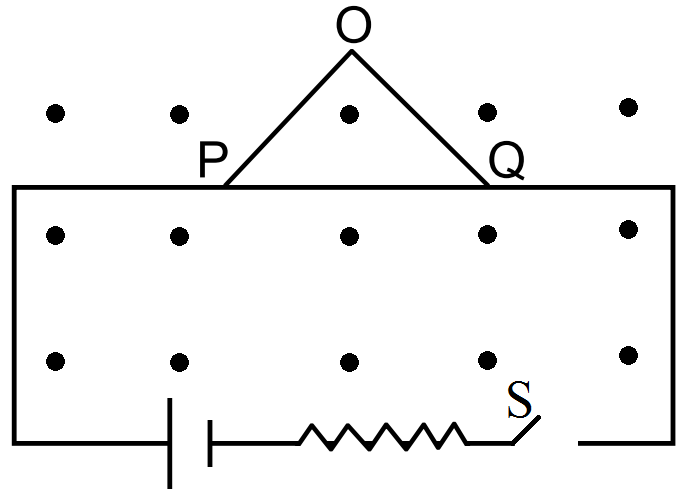
Shows a rod PQ of length 20.0cm and mass 200g suspended through a fixed point O by two threads of lengths 20.0cm each. A magnetic field of strength 0.500T exists in the vicinity of the wire PQ, as shown in the figure. The wires connecting PQ with the battery are loose and exert no force on PQ.
  1. Find the tension in the threads when the switch S is open.
  2. A current of 2.0A is established when the switch S is closed. Find the tension in the threads now.
The half-life of ${ }^{226} \mathrm{Ra}$ is 1602 y . Calculate the activity of 0.1 g of $\mathrm{RaCl}_2$ in which all the radium is in the form of ${ }^{226} \mathrm{Ra}$. Taken atomic weight of Ra to be $226 \mathrm{~g} / \mathrm{mol}^{-1}$ and that of Cl to be $35.5 \mathrm{~g} / \mathrm{mol}^{-1}$.
The moon rotates about the earth in such a way that only one hemisphere of the moon faces the earth. Can we ever see the ''other face'' of the moon from the earth? Can a person on the moon ever see all the faces of the earth?
You are waiting for a train on a railway platform. Your three year old niece is standing on your iron trunk containing the luggage. Why does the trunk not recoil as she jumps off on the platform?
The saturation current in a triode valve can be changed by changing:
  1. The grid voltage.
  2. The plate voltage.
  3. The separation between the grid and the cathode.
  4. The temperature of the cathode.
Read the passage given below and answer the following questions from 1 to 5. In general, the errors in measurement can be broadly classified as (a) systematic errors and (b) random errors. Systematic errors: The systematic errors are those errors that tend to be in one direction, either positive or negative. Some of the sources of systematic errors are: (a) Instrumental errors that arise from the errors due to imperfect design or calibration of the measuring instrument, zero error in the instrument, etc. For example, the temperature graduations of a thermometer may be inadequately calibrated (it may read 104 °C at the boiling point of water at STP whereas it should read 100 °C); in a vernier calipers the zero mark of vernier scale may not coincide with the zero mark of the main scale, or simply an ordinary metre scale may be worn off at one end. (b) Imperfection in experimental technique or procedure to determine the temperature of a human body, a thermometer placed under the armpit will always give a temperature lowers than the actual value of the body temperature. (c) Personal errors that arise due to an individual’s bias, lack of proper setting of the apparatus or individual’s carelessness in taking observations without observing proper precautions, etc. For example, if you, by habit, always hold your head a bit too far to the right while reading the position of a needle on the scale, you will introduce an error due to parallax.Systematic errors can be minimized by improving experimental techniques, selecting better instruments and removing personal bias as far as possible. For a given set-up, these errors may be estimated to a certain extent and the necessary corrections may be applied to the readings. Random errors:The random errors are those errors, which occur irregularly and hence are random with respect to sign and size. These can arise due to random and unpredictable fluctuations in experimental conditions (e.g. unpredictable fluctuations in temperature, voltage), personal (unbiased) errors by the observer taking readings, etc. For example, when the same person repeats the same observation, it is very likely that he may get different readings every time. Least count error: The smallest value that can be measured by the measuring instrument is called its least count. All the readings or measured values are good only up to this value. The least count error is the error associated with the resolution of the instrument.
  1. The errors due to imperfect design or calibration of the measuring instrument:
  1. Instrumental error
  2. Random error
  3. Least count error
  4. None of the above
  1. The errors which occur irregularly
  1. Instrumental error
  2. Personal error
  3. Random error
  4. None of these
  1. Write a note on least count error
  1. Write a note on random error
  1. Write a note on systematic error
Read the passage given below and answer the following questions from 1 to 5. Power is defined as the time rate at which work is done or energy is transferred. The average power of a force is defined as the ratio of the work, W, to the total time t taken $P_{av}= W/t$ The instantaneous power is defined as the limiting value of the average power as time interval approaches zero. P = dw/dt The work dW done by a force F for a displacement dr is dW = F.dr. The instantaneous power can also be expressed as P = F.dr/dt P = F.v Where v is the instantaneous velocity when the force is F. Power, like work and energy, is a scalar quantity. Its dimensions are $[ML^2 T^{-3}]$. In the SI, its unit is called a watt (W). The watt is $1 J s^{-1}$. The unit of power is named after James Watt, one of the innovators of the steam engine in the eighteenth century. There is another unit of power, namely the horse-power (hp) 1 hp = 746W This unit is still used to describe the output of automobiles, motorbikes.
  1. The time rate at which work is done or energy is transferred is called as:
  1. Energy
  2. Force
  3. Power
  4. None of these
  1. Limiting value of power as time interval approaches zero is called as:
  1. Average power
  2. Instantaneous power
  3. Both a and b
  4. None of these
  1. Power is directly proportional to:
  1. Force
  2. Velocity
  3. Both
  4. None of these
  1. Define instantaneous power. Give its SI unit and dimensions.
  1. 1 horse power is equal to how many watt?