Question
In order to emit the electron from the metallic surface, which physical methods are used to give the minimum energy? Explain.

Answer

The minimum energy can be given by one of the following methods :
I. Thermionic emission
II. Field emission
III. Photoelectric emission.
I. Thermionic emission : Through thermionic emission, sufficient thermal energy can be given to the free electrons, so that they can come out of the metal.
II. Field emission : A strong electric field of the order of $10^8$ volts applied on a metal can emit electrons from the metal surface. As occurs in a spark plug.
III. Photoelectric emission : When light of appropriate frequency falls on a metal surface, electrons are emitted. These light generated electrons are called photoelectrons.

Need a full question paper?

Generate a complete, print-ready paper with questions like this in minutes — across 16+ boards, with answer keys.
Start Generating Free

Similar questions

  1. What characteristic property of nuclear force explains the constancy of binding energy per nucleon (BE/A) in the range of mass number 'A' lying 30
    • Show that the density of nucleus over a wide range of nuclei is constantindependent of mass numberA.
The electric field associated with a monochromatic beam becomes zero $1.2 \times 10^{15}$ times per second. Find the maximum kinetic energy of the photoelectrons when this light falls on a metal surface whose work function is 2.0eV.
Write symbolically the nuclear $\beta^{+}$decay process of $^{11}_{6}\text{C}$ . Is the decayed product X an isotope or isobar of $^{11}_{6}\text{C}$?
Given the mass values m $(^{11}_{6}\text{C})$ = 11·011434 u and m (X) = 11·009305 u. Estimate the Q-value in this process.
An electron and alpha particle have the same kinetic energy. How are the de Broglie wavelengths associated with them related?
In a p-n junction, a potential barrier of 250meV exists across the junction. A hole with a kinetic energy of 300meV approaches the junction. Find the kinetic energy of the hole when it crosses the junction if the hole approached the junction.
  1. From the p-side.
  2. From the n-side.
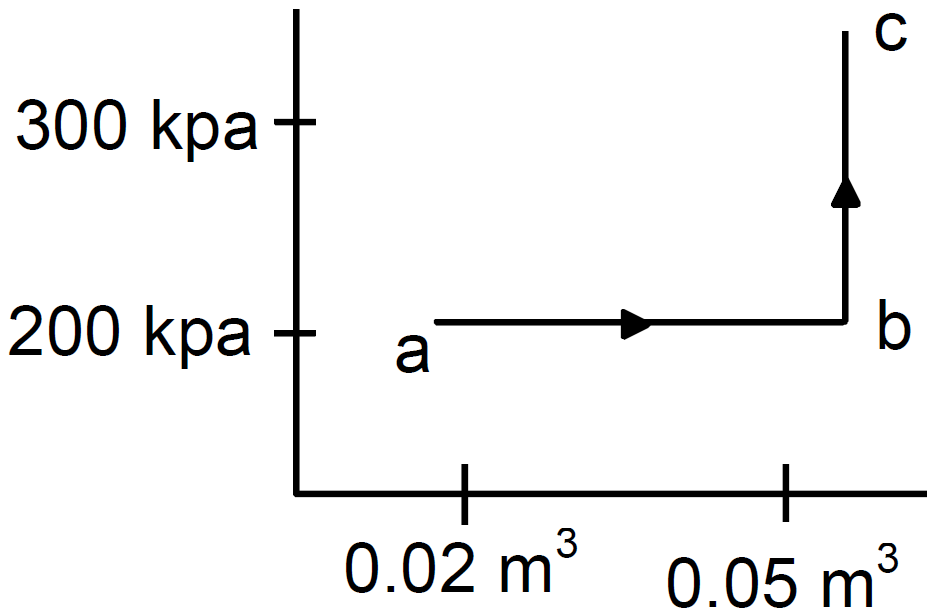
A substance is taken through the process abc as shown in figure. If the internal energy of the substance increases by 5000J and a heat of 2625cal is given to the system, calculate the value of J.
A compass needle free to turn in a horizontal plane is placed at the centre of circular coil of 30 turns and radius 12 cm. The coil is in a vertical plane making an angle of 45° with the magnetic meridian. When the current in the coil is 0.35 A, the needle points west to east.
  1. Determine the horizontal component of the earth’s magnetic field at the location.
  2. The current in the coil is reversed, and the coil is rotated about its vertical axis by an angle of 90° in the anticlockwise sense looking from above. Predict the direction of the needle. Take the magnetic declination at the places to be zero.
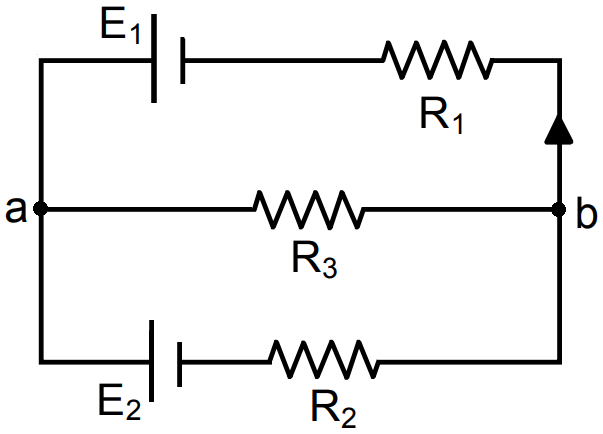
Find the potential difference $V_a - V_b$ in the circuits shown in figure.

A concrete slab has a length of 10m on a winter night when the temperature is 0°C. Find the length of the slab on a summer day when the temperature is $35^\circ C.$ The coefficient of linear expansion of concrete is ${1.0 \times 10^{-5­}}^\circ C^{-1}$.
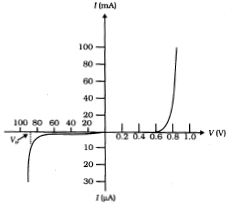
The figure below shows the $\text{V-I}$ characteristic of a semiconductor diode.
  1. Identify the semiconductor diode used.
  2. Draw the circuit diagram to obtain the given characteristic of this device.
  3. Briefly, explain how this diode can be used as a voltage regulator.