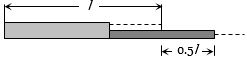
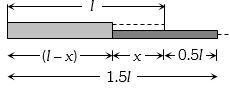
In order to quadruple the resistance of a uniform wire, a part of its length was uniformly stretched till the final length of the entire wire was $1.5$ times the original length, the part of the wire was fraction equal to
Diffcult


Download our appand get started for free
Experience the future of education. Simply download our apps or reach out to us for more information. Let's shape the future of learning together!No signup needed.*
Similar Questions
- 1The $e.m.f.$ of a standard cell balances across $150\, cm$ length of a wire of potentiometer. When a resistance of $2\,\Omega $ is connected as a shunt with the cell, the balance point is obtained at $100\,cm$. The internal resistance of the cell is .............. $\Omega $View Solution
- 2$10$ wires (same length, same area, same material) are connected in parallel and each has $1$ $\Omega$ resistance, then the equivalent resistance will be .............. $\Omega$View Solution
- 3View SolutionThe specific resistance of all metals is most affected by
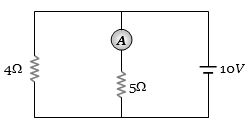
- 4In the circuit, the reading of the ammeter is ................. $A$ (assume internal resistance of the battery be zero)View Solution
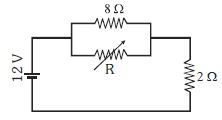
- 5The value of the resistance $R$ in figure is adjusted such that power dissipated in the $2\,\Omega $ resistor is maximum. Then the power dissipated in the $2\,\Omega $ will be ................ $W$View Solution
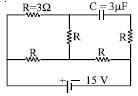
- 6In the circuit shown, the cell is ideal, with $emf$ $=$ $15$ $V$. Each resistance is of $3 $ $\Omega$ . The potential difference across the capacitor is.....$V$View Solution
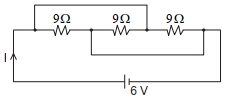
- 7The current $I$ flowing through the given circuit will be $.....A$.View Solution
- 8Two cells when connected in series are balanced on $8\;m$ on a potentiometer. If the cells are connected with polarities of one of the cell is reversed, they balance on $2\,m$. The ratio of $e.m.f.$'s of the two cells isView Solution
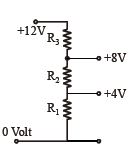
- 9A potential divider is used to give outputs of $4\,V$ and $8\,V$ from a $12\,V$ source. Which combination of resistances, $(R_1 : R_2 : R_3)$ gives the correct voltagesView Solution
- 10In copper wire each atom releases one free electron. If diameter is $1\, mm$ and current is $1.1\,A$ find drift velocity. ($\rho = 9 \times 10^{+3}\, kg/m^3$ $M = 63\, gm/mole$)View Solution