Question
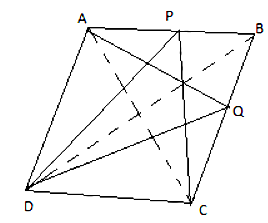
In parallelogram $\text{ABCD, P}$ is a point on side $AB$ and $Q$ is a point on side $BC$.Prove that:$(i) \triangle CPD$ and $\triangle AQD$ are equal in the area.$(ii)$ Area $(\triangle AQD) =$ Area $(\triangle APD) +$ Area $(\triangle CPB)$
Answer


Given $\text{ABCD}$ is a parallelogram.
$P$ and $Q$ are any points on the sides $AB$ and $BC$ respectively,
join diagonals $AC$ and $BD.$
proof:
$(i)$ since triangles with the same base and between the same set of parallel lines have equal areas
area $(CPD) =$ area$(BCD) \dots…… (1)$
again, diagonals of the parallelogram bisect area in two equal parts
area $(BCD) = (1/2)$ area of parallelogram$ ABCD\dots …… (2)$
from $(1)$ and $(2)$
area$(CPD) = 1/2$ area$(ABCD)\dots …… (3)$
similarly area $(AQD) =$ area$(ABD) = 1/2$ area$(\text{ABCD})\dots…… (4)$
from $(3)$ and $(4)$
area$(CPD) =$ area$(AQD),$
hence proved.
$(ii)$ We know that area of triangles on the same base and between same parallel lines are equal
So Area of $AQD=$ Area of $ACD=$ Area of $PDC =$ Area of $BDC =$ Area of $ABC=$Area of $APD +$ Area of $BPC$
Hence Proved

Need a full question paper?

Generate a complete, print-ready paper with questions like this in minutes — across 16+ boards, with answer keys.

Start Generating Free