MCQ
In SI system the fundamental units are
  • A
    meter, kilogram, second, ampere, Kelvin, mole and watt
  • B
    meter, Newton, second, ampere, Kelvin, mole and candela
  • C
    meter, kilogram, second, coulomb, Kelvin, mole, candela and horse power
  • D
    meter, kilogram, second, ampere, Kelvin, mole and candela

Need a full question paper?

Generate a complete, print-ready paper with questions like this in minutes — across 16+ boards, with answer keys.

Start Generating Free

Similar questions

A girl weighing 50kg makes a high jump of 1.2m. What is her kinetic energy at the highest point? (g = 10ms−2)
At critical temperature, the surface tension of a liquid
Two wires $A$ and $B$ of same length and of same material have radii $r_1$ and $r_2$ respectively. Their one end is fixed with a rigid support and at other end equal twisting couple is applied. Then ratio of the angle of twist at the end of $A$ and the angle of twist at the end of $B$ will be ..............
A body of mass $m$ is tied to one end of a spring and whirled round in a horizontal plane with a constant angular velocity. The elongation in the spring is one centimetre. If the angular velocity is doubled, the elongation in the spring is $5\, cm$ . The original length of the spring is ............ $cm$
Match List $I$ with List $II$ :

List $I$ List $II$
$A$ Isothermal Process $I$ Work done by the gas decreases internal energy
$B$ Adiabatic Process $II$ No change in internal energy
$C$ Isochoric Process $III$ The heat absorbed goes partly to increase internal energy and partly to do work
$D$ Isobaric Process $IV$ No work is done on or by the gas

Choose the correct answer from the options given below :

Supposing Newton’s law of gravitation for gravitation forces F1 and F2 between two masses m1 and m2 at positions r1 and r2 read $\text{F}_1=-\text{F}_2=-\frac{\text{r}^{12}}{\text{r}^3_{12}}\text{GM}_0^2\Big(\frac{\text{m}_1\text{m}_2}{\text{M}^2_0}\Big)^\text{n}$ where Mis a constant of dimension of mass, r12 = r1 – r2 and n is a number. In such a case,
  1. The acceleration due to gravity on earth will be different for different objects.
  2. None of the three laws of Kepler will be valid.
  3. Only the third law will become invalid.
  4. For n negative, an object lighter than water will sink in water.
A plane progressive wave is represented by the equation $y = 0.1\sin \left( {200\pi t - \frac{{20\pi x}}{{17}}} \right)$ where y is displacement in $m$, $ t$ in second and $x$ is distance from a fixed origin in meter. The frequency, wavelength and speed of the wave respectively are
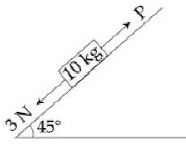
A block of mass $10\, kg$ is kept on a rough inclined plane as shown in the figure. A force of $3\, N$ is applied on the block. The coefficient of static friction between the plane and the block is $0.6$. What should be the minimum value of force $P$, such that the block does not move downward? (take $g = 10\, ms^{-2}$) ........ $N$
Under elastic limit the stress is 
From the top of a tower, two stones whose masses are in the ratio 1 : 2 are thrown, one straight up with an initial speed u and the second straight down with same speed u. neglecting air resistance,