MCQ
In simple harmonic motion :
  • A
    The value of art is fixed
  • B
    The value of kinetic energy is constant
  • C
    The value of potential energy is constant
  • The value of dimension is fixed

Answer

Correct option: D.
The value of dimension is fixed
(D)

Need a full question paper?

Generate a complete, print-ready paper with questions like this in minutes — across 16+ boards, with answer keys.

Start Generating Free

Similar questions

If the external forces acting on a system have zero resultant, the centre of mass:
One gm mol of a diatomic gas $(\gamma = 1.4)$ is compressed adiabatically so that its temperature rises from ${27^o}C$ to ${127^o}C$. The work done will be
The $\text{r.m.s}$ velocity of the molecules of an ideal gas is $C$ at a temperature of $100K.$ at what temperature is $\text{r.m.s.}$ velocity will be doubted?
Variation of atmospheric pressure, with height from earth is ................
A particle executes $S.H.M.$ of amplitude A along $x$-axis. At $t =0$, the position of the particle is $x=\frac{A}{2}$ and it moves along positive $x$-axis the displacement of particle in time $t$ is $x=A \sin (\omega t+\delta)$, then the value $\delta$ will be
The value of the radius of gyration of a body does not depend on:
A body of mass $1000 \mathrm{~kg}$ is moving horizontally with a velocity $6 \mathrm{~m} / \mathrm{s}$. If $200 \mathrm{~kg}$ extra mass is added, the final velocity (in $\mathrm{m} / \mathrm{s}$ ) is:
A particle of mass $m$ is initially at rest at the origin. It is subjected to a force and starts moving along the $x$-axis. Its kinetic energy $K$ changes with time as $dK / dt =\gamma$ t, where $\gamma$ is a positive constant of appropriate dimensions. Which of the following statements is (are) true?

$(A)$ The force applied on the particle is constant

$(B)$ The speed of the particle is proportional to time

$(C)$ The distance of the particle from the origin increases linearly with time

$(D)$ The force is conservative

Force in Column - $\mathrm{I}$ and its use is in Column - $\mathrm{II}$ are given. Match them appropriately.
Column - $\mathrm{I}$ Column - $\mathrm{II}$
$(a)$ Cohesive force $(i)$ Useful for writing by chalk on blackboard.
$(b)$ Adhesive force $(ii)$ Useful in soldering.
  $(iii)$Useful for formation of spherical drops of liquid.
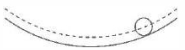
A ball is rolling without slipping in a spherical shallow bowl (radius $R$ ) as shown in the figure and is executing simple harmonic motion. If the radius of the ball is doubled, then the time period of oscillation