MCQ
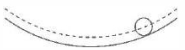
A ball is rolling without slipping in a spherical shallow bowl (radius $R$ ) as shown in the figure and is executing simple harmonic motion. If the radius of the ball is doubled, then the time period of oscillation
  • A
    increases slightly
  • B
    is reduced by a factor of $1 / 2$
  • C
    is increased by a factor of $2$
  • decreases slightly

Answer

Correct option: D.
decreases slightly
d
(d)

Time period of oscillation of ball (radius $r$ ) in a bowl (radius $R$ ) rolling without slipping is

$T=2 \pi \sqrt{\frac{R-r}{g}}$

So, if $r$ increases, then time period is decreases.

Need a full question paper?

Generate a complete, print-ready paper with questions like this in minutes — across 16+ boards, with answer keys.

Start Generating Free

Similar questions

The quantities remaining constant in a collisions are
A bullet fired into a fixed target loses half of its velocity after penetrating $3\,cm$. How much further it will penetrate before coming to rest assuming that it faces constant resistance to motion?........$cm$
$A$ man of mass $M$ stands at one end of a plank of length $L$ which lies at rest on a frictionless surface. The man walks to other end of the plank. If the mass of the plank is $\frac{M}{3}$ , then the distance that the man moves  relative to ground is :
A bullet of mass $40 \,g$ is fired from a gun of mass $10 \,kg$. If velocity of bullet is $400 \,m / s$, then the recoil velocity of the gun will be ..........
An ideal monoatomic gas expands to twice its volume. If the process is isothermal, the magnitude of work done by the gas is $W_i$. If the process is adiabatic, the magnitude of work done by the gas is $W_a$. Which of the following is true?
A musician using an open flute of length $50\,cm$ produces second harmonic sound waves. A person runs towards the musician from another end of a hall at a speed of $10 \,km/h.$ If the wave speed is $330\,m/s,$ the frequency heard by the running person shall be close to...... $Hz$
If a particle takes $t$ second less and acquires a velocity of $v ms ^{-1}$ more in falling through the same distance on two planets, where the accelerations due to gravity are $2\,g$ and $8\,g$ respectively, then
A body rotating with an angular speed of $600\, {rpm}$ is uniformly accelerated to $1800 \,{rpm}$ in $10\; sec$. The number of rotations made in the process is ..... .
A particle is moving on a circular path of radius $r$ with uniform speed $v$. The magnitude of change in velocity when the particle moves from $P$ to $Q$ is  $(\angle POQ = 40^o)$
An inductor coil of some resistance is connected to an $AC$ source. Which of the following quantities have zero average value over a cycle?