MCQ
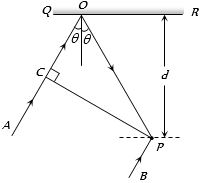
In the adjacent diagram,$ CP$ represents a wavefront and $AO$ & $BP$, the corresponding two rays. Find the condition on $\theta$ for constructive interference at $P$ between the ray $BP$ and reflected ray $OP$
  • A
    $cos \theta = 3 \lambda /2d$
  • $cos \theta = \lambda /4d$
  • C
    $sec \theta -cos \theta  =  \lambda /d$
  • D
    $sec \theta -cos \theta  = 4 \lambda /d$
Answer

Correct option: B.
$cos \theta = \lambda /4d$
b
(b)$PR = d ==> PO = d sec \theta$ and $CO = PO\, cos\, 2 \theta = d \,sec \theta \cos 2 \theta $ is

Path difference between the two rays
$\Delta = CO + PO = (d \,sec \theta  + d\, sec\, \theta \,cos\, 2 \theta )$
Phase difference between the two rays is
$\phi = \pi$ (One is reflected, while another is direct)
Therefore condition for constructive interference should be $\Delta = \frac{\lambda }{2},\frac{{3\lambda }}{2}......$
or $d\sec \theta (1 + \cos 2\theta ) = \frac{\lambda }{2}$
or $\frac{d}{{\cos \theta }}(2{\cos ^2}\theta ) = \frac{\lambda }{2}$ ==> $\cos \theta = \frac{\lambda }{{4d}}$

Need a full question paper?

Generate a complete, print-ready paper with questions like this in minutes — across 16+ boards, with answer keys.

Start Generating Free

Similar questions

$1\ gm$ of ice at $0^o C$ is mixed with $1gm$ of water at $100^o C$ the resulting temperature will be .......... $^oC$ 
If the momentum of a body is increased $n$ times, its kinetic energy increases
There are $8$ equal resistances $R$. Two are connected in parallel, such four groups are connected in series, the total resistance of the system will be
In Vander Waal’s equation $a$ and $b$ represent $\left( {P + \frac{a}{{{V^2}}}} \right)\,(V - b) = RT$
Energy of $10$ non rigid diatomic molecules at temperature $\mathrm{T}$ is :
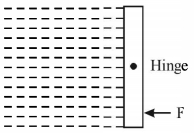
A square gate of size $1\,m \times 1\,m$ is hinged at its mid-point. A fluid of density $\rho$ fills the space to the left of the gate. The force F required to hold the gate stationary is
A clock which keeps correct time at ${20^o}C$, is subjected to ${40^o}C$. If coefficient of linear expansion of the pendulum is $12 \times {10^{ - 6}}/^\circ C$. How much will it gain or loose in time
Two identical blocks $A$ and $B$ each of mass $m$ resting on the smooth horizontal floor are connected by a light spring of natural length $L$ and spring constant $K$. A third block $C$ of mass $m$ moving with a speed $v$ along the line joining $A$ and $B$ collides with $A$.The maximum compression in the spring is
A particle of mass $m$ is moving in a circular path of constant radius $I$ such that its centripetal acceleration $(a)$ is varying with time $t$ as $a=k^{2} rt^{2}$. where $k$ is a constant. The power delivered to the particle by the force acting on it is given as
Two solid spheres of different mass, radii and density roll down a rough inclined plane under identical situation. Their time to come down is independent of their ............
