Consider a block of conducting material ofresistivity '$\rho$' shown in the figure. Current '$I$' enters at '$A$' and leaves from '$D$'. We apply superp osition principle to find voltage '$\Delta V$ ' developed between '$B$' and '$C$'. The calculation is done in the following steps:
$(i)$ Take current '$I$' entering from '$A$' and assume it to spread over a hemispherical surface in the block.
$(ii)$ Calculatefield $E(r)$ at distance '$r$' from $A$ by using Ohm's law $E = \rho j$, where j is the current per unit area at '$r$'.
$(iii)$ From the '$r$' dependence of $E(r)$, obtain the potential $V(r)$ at $r$.
$(iv)$ Repeat $(i), (ii)$ and $(iii)$ for current '$I$' leaving '$D$' and superpose results for '$A$' and '$D$'.
$(i)$ Take current '$I$' entering from '$A$' and assume it to spread over a hemispherical surface in the block.
$(ii)$ Calculatefield $E(r)$ at distance '$r$' from $A$ by using Ohm's law $E = \rho j$, where j is the current per unit area at '$r$'.
$(iii)$ From the '$r$' dependence of $E(r)$, obtain the potential $V(r)$ at $r$.
$(iv)$ Repeat $(i), (ii)$ and $(iii)$ for current '$I$' leaving '$D$' and superpose results for '$A$' and '$D$'.
For current entering at $A$, the electric field at a distance '$r$'
from $A$ is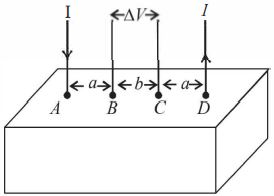
AIEEE 2008, Diffcult
Download our app for free and get started
Let j be the current density.
Then $j \times 2 \pi r^{2}=I \Rightarrow j=\frac{I}{2 \pi r^{2}} \therefore E=\rho j=\frac{\rho I}{2 \pi r^{2}}$
Now, $\Delta V_{BC}^\prime = - \int\limits_{a + b}^a {\vec E} .\overline {dr} = - \int\limits_{a + b}^a {\frac{{\rho I}}{{2\pi {r^2}}}dr} $
$=-\frac{\rho I}{2 \pi}\left[-\frac{1}{r}\right]_{a+b}^{a}=\frac{\rho I}{2 \pi a}-\frac{\rho I}{2 \pi(a+b)}$
On applying superposition as mentioned we get
$\Delta V_{B C}=2 \times \Delta V_{B C}^{\prime}=\frac{\rho I}{\pi a}-\frac{\rho I}{\pi(a+b)}$
As shown above $\quad E=\frac{\rho I}{2 \pi r^{2}}$

Download our appand get started for free
Experience the future of education. Simply download our apps or reach out to us for more information. Let's shape the future of learning together!No signup needed.*
Similar Questions
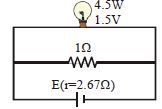
- 1A torch bulb rated as $4.5\, W, 1.5\, V$ is connected as shown in the figure. The $e.m.f.$ of the cell needed to make the bulb glow at full intensity is ............. $V$View Solution
- 2A battery having $e.m.f.$ $5\,\,V$ and internal resistance $0.5$ $\Omega$ is connected with a resistance of $4.5 \,\Omega$ then the voltage at the terminals of battery is ............. $V$View Solution
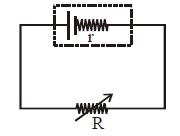
- 3Which of the following graphs represent the variation of power loss in the external load with external resistance $R$?View Solution
- 4A metal wire of specific resistance $64 \times {10^{ - 6}}\,ohm - cm$ and length $198\, cm$ has a resistance of $7\, ohm$, the radius of the wire will be ............. $cm$View Solution
- 5Two electric lamps of $40\, watt$ each are connected in parallel. The power consumed by the combination will be ........... $watt$View Solution
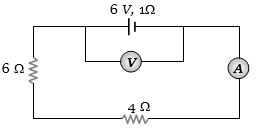
- 6View SolutionIn the circuit shown here, the readings of the ammeter and voltmeter are
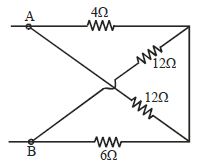
- 7In given Network the equivalent resistance between $A$ and $B$ is .............. $\Omega$View Solution
- 8Five identical cells each of internal resistance $1\, \Omega$ and $emf \;5\, {V}$ are connected in series and in parallel with an external resistance $'R'.$ For what value of $'R',$ current in series and parallel combination will remain the same ? (in $\Omega$)View Solution
- 9View SolutionPotential gradient is defined as
- 10The electric current through a wire varies with time as $I=I_0+\beta t$. where $I_0=20 \mathrm{~A}$ and $\beta=3 \mathrm{~A} / \mathrm{s}$. The amount of electric charge crossed through a section of the wire in $20 \mathrm{~s}$ is :View Solution