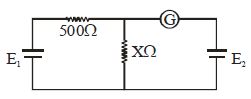
In the adjoining circuit, the battery $E_1$ has an emf of $12\, volt$ and zero internal resistance while the battery $E_2$ has an $emf$ of $2\, volt$. If the galvanometer $G$ reads zero, then the value of the resistance $X$ (in $ohm$ ) is
Medium
Download our app for free and get started
Current across $(500 \Omega) \rightarrow$
$I=\frac{E_{1}-E_{2}}{500}$ ............$(1)$
$\mathrm{E}_{2}=\mathrm{IX}$ .........$(2)$

Download our appand get started for free
Experience the future of education. Simply download our apps or reach out to us for more information. Let's shape the future of learning together!No signup needed.*
Similar Questions
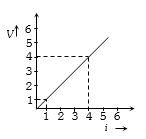
- 1Variation of current and voltage in a conductor has been shown in the diagram below. The resistance of the conductor is. ........... $ohm$View Solution
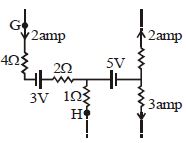
- 2In the part of a circuit shown in the figure, the potential difference $(V_G -V_H)$ between points $G$ and $H$ will be ............... $V$View Solution
- 3In a neon discharge tube $2.9 \times {10^{18}}\,N{e^ + }$ ions move to the right each second while $1.2 \times {10^{18}}$ electrons move to the left per second. Electron charge is $1.6 \times {10^{ - 19}}\,C$. The current in the discharge tubeView Solution
- 4The charge flowing in a conductor changes with time as $Q ( t )=\alpha t -\beta t ^2+\gamma t ^3$. Where $\alpha, \beta$ and $\gamma$ are constants. Minimum value of current is :View Solution
- 5A wire when connected to $220\,V$ mains supply has power dissipation ${P_1}$. Now the wire is cut into two equal pieces which are connected in parallel to the same supply. Power dissipation in this case is ${P_2}$. Then ${P_2}:{P_1}$ isView Solution
- 6At room temperature, copper has free electron density of $8.4 \times {10^{28}}$ per ${m^3}$. The copper conductor has a cross-section of $10^{-6} \,m^2$ and carries a current of $5.4\, A$. The electron drift velocity in copper isView Solution
- 7View SolutionThe electric current passing through a metallic wire produces heat because of
- 8The terminal potential difference of a cell when short-circuited is ($E$ = $E.M.F.$ of the cell)View Solution
- 9If a wire of resistance $R$ is melted and recasted to half of its length, then the new resistance of the wire will beView Solution
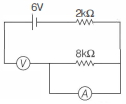
- 10In the circuit shown below, a student performing Ohm's law experiment accidently puts the voltmeter and the ammeter as shown in the circuit below. The reading in the voltmeter will be close to .......... $V$View Solution