Question
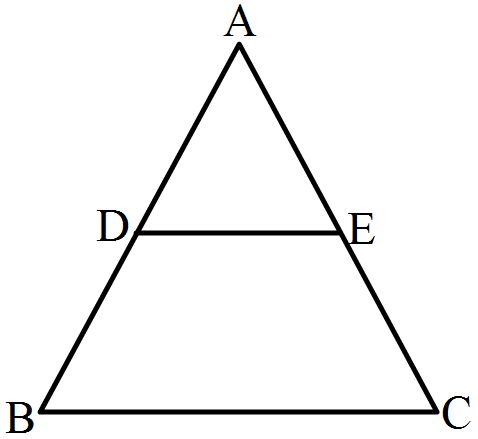
In the adjoining figure, ABC is a triangle in which AB = AC. If D and E are points on AB and AC respectively such that AD = AE, show that the points B, C, E and D are concyclic.
Answer

Given:
AD = AE ...(i)
AB = AC ...(ii)
Subtracting AD from both sides, we get:
⇒ AB - AD = AC - AD
⇒ AB - AD = AC - AE (Since, AD = AE)
⇒ BD = EC ...(iii)
Dividing equation (i) by equation (iii), we get:
$\frac{\text{AD}}{\text{DB}}=\frac{\text{AE}}{\text{EC}}$
Dividing the converse pf Thales' theorem, DE || BC
$\Rightarrow\angle\text{DEC}+\angle\text{ECB}=180^\circ$ (Sum of interior angles on the same side of a transversal line is 180º)
$\Rightarrow\angle\text{DEC}+\angle\text{CBD}=180^\circ$ $($Since, AB = AC ⇒ $\angle\text{B}=\angle\text{C})$
Hence, quadrilateral BDED is cyclic.
Therefore, B, C, E and D are concyclic points.

Need a full question paper?

Generate a complete, print-ready paper with questions like this in minutes — across 16+ boards, with answer keys.
Start Generating Free

Similar questions

The semi perimeter of a rectangular shape garden is 36 m. The length of the garden is 4 m more than its breadth. Find the length and the breadth of the garden.
Solve the following systems of equations by using the method of cross multiplication:
$\frac{1}{\text{x}}+\frac{1}{\text{y}}=7,$
$\frac{2}{\text{x}}-\frac{3}{\text{y}}=17 $ $(\text{x}\neq0,\ \text{y}\neq0).$
A cylindrical bucket of diameter 28 cm and height 20 cm was full of sand. When the sand in the bucket was poured on the ground, the sand got converted into a shape of a cone. If the height of the cone was 14 cm, what was the base area of the cone?
A man travels by boat 36 km down a river and back in 8 hours. If the speed of his boat in still water is 12 km/hr, find the speed of the river current.
In the given figure, $O$ is the centre of the bigger circle, and $A C$ is its diameter. Another circle with $A B$ as diameter is drawn. If $AC =54 cm$ and $BC =10 cm$, find the area of the shaded region.
Solve the following systems of equations:
$\frac{1}{2\text{x}}+\frac{1}{3\text{y}}=2$
$\frac{1}{3\text{x}}+\frac{1}{2\text{y}}=\frac{13}{6}$
In the following, determine whether the given values are solution of the given equation or not:
$\text{x}+\frac{1}{\text{x}}=\frac{13}{6},$ $\text{x}=\frac{5}{6},\text{x}=\frac{4}{3}$
Neeta saves in a 'Mahila Bachat Gat' ₹ 2 on the first day, ₹ 4 on the second day, ₹ 6 on the third day and so on. What will be her saving in the month of February 2010 ?
State the converse of Pythagpras' theorem.