Question
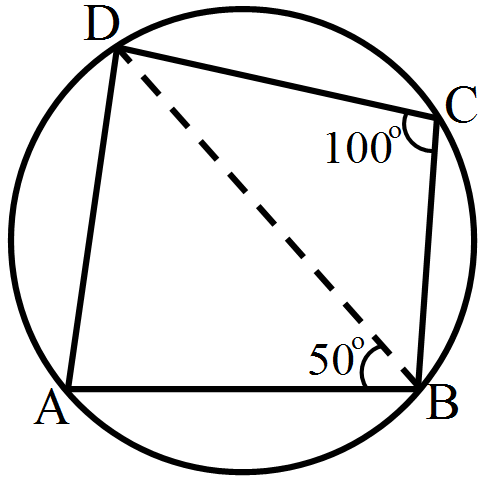
In the adjoining figure, ABCD is a cyclic quadrilateral in which $\angle\text{BCD}=100^\circ$ and $\angle\text{ABD}=50^\circ.$ Find $\angle\text{ADB}.$
Answer

ABCD is a cyclic quadrilateral.$\therefore\ \angle\text{A}+\angle\text{C}=180^\circ$ [Opposite of a cyclic quadrilateral are supplementary]
$\Rightarrow\ \angle\text{A}+100^\circ=180^\circ$
$\Rightarrow\ \angle\text{A}=180^\circ-100^\circ=80^\circ$
Now, in $\triangle\text{ABD},$ we have:$\angle\text{A}+\angle\text{ABD}+\angle\text{ADB}=180^\circ$
$\Rightarrow\ 80^\circ+50^\circ+\angle\text{ADB}=180^\circ$
$\Rightarrow\ \angle\text{ADB}=180^\circ-130^\circ=50^\circ$
$\therefore\ \angle\text{ADB}=50^\circ$

Need a full question paper?

Generate a complete, print-ready paper with questions like this in minutes — across 16+ boards, with answer keys.
Start Generating Free

Similar questions

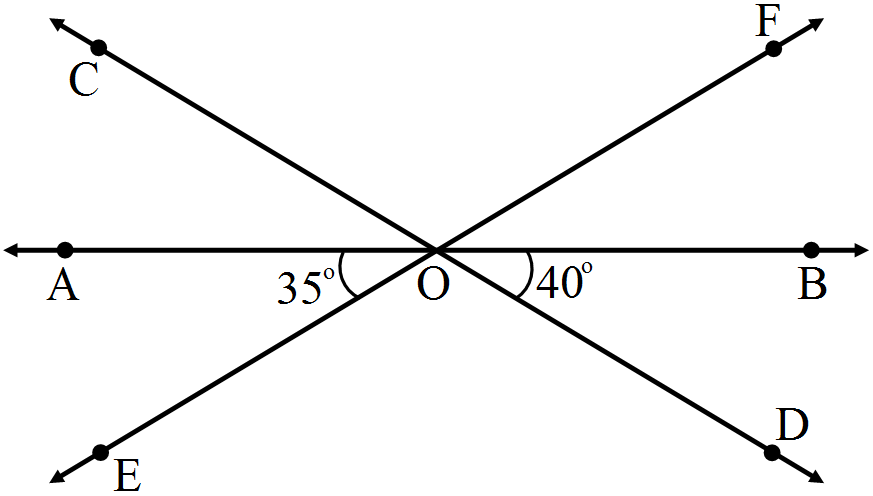
In the given figure, three lines AB, CD and EF intersect at a point O such that $\angle\text{AOE}=35^\circ$ and $\angle\text{BOD}=40^\circ.$ Find the measure of $\angle\text{AOC},\angle\text{BOF},\angle\text{COF}$ and $\angle\text{DOE}.$
Take different examples of sets and verify the above mentioned properties.
The diagonals of a cyclic quadrilateral are at right angles. Prove that the perpendicular from the point of their intersection on any side when produced backwards, bisects the opposite side.
If $f(t) = 4t^2 - 3t + 6$, find:
  1. f(0)
  2. f(4)
  3. f(-5)
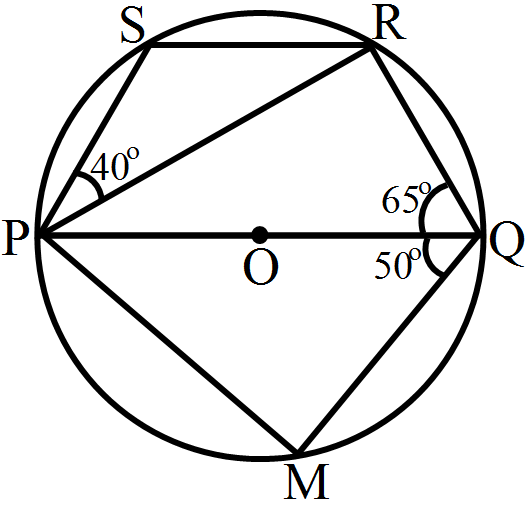
In the given figure, PQ is a diameter of a circle with centre O. If $\angle\text{PQR}=65^\circ,\angle\text{SPR}=40^\circ$ and $\angle\text{PQM}=65^\circ,$ find $\angle\text{QPR},\angle\text{QPM}$ and $\angle\text{PRS}.$
The following table gives the quantity of goods (in crores of rupees)
Year
1950–51
1960–61
1965–66
1970–71
1980–81
1982–83
Quantity of goods (in crore tonnes)
9
16
20
20
22
26
Represent this information with the help of a bar graph.
In a quadrilateral ABCD, show that (AB + BC + CD + DA) > (AC + BD).
Without plotting the points on a graph, state in which quadrant or on which axis do the following points lie.
i. (5, -3)
ii. (-7, -12)
iii. (-23, 4)
iv. (-9, 5)
v. (0, -3)
vi. (-6, 0)
Construct △ ABC in which BC = 6.3 cm, ∠B = 75° and AB + AC = 9 cm.
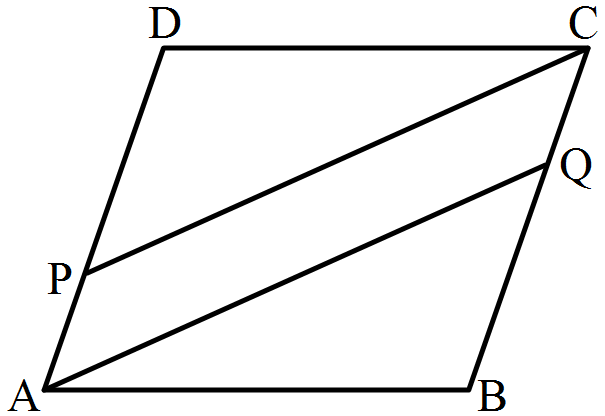
In the adjoining figure, ABCD is a parallelogram. If P and Q are points on AD and BCrespectively such that $\text{AP}=\frac{1}{2}\text{AD}$ and $\text{CQ}=\frac{1}{2}\text{BC},$ prove that AQCP is a parallelogram.