Question
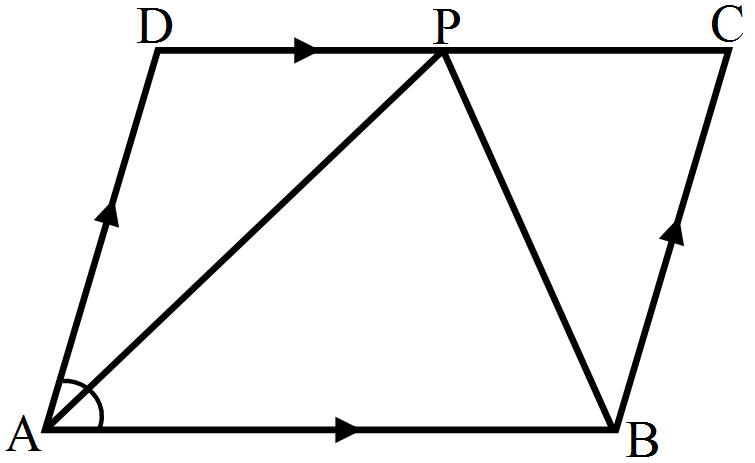
In the adjoining figure, ABCD is a parallelogram in which $\angle\text{A}=60^{\circ}.$ If the bisectors of $\angle\text{A}$ and $\angle\text{B}$ meet DC at P, prove that
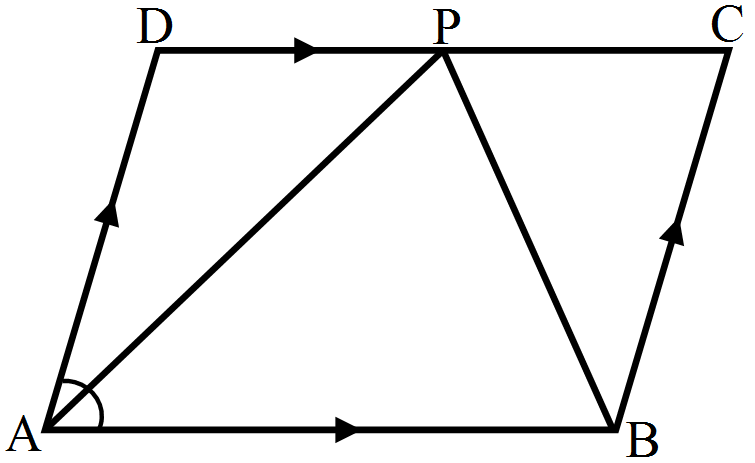
  1. $\angle\text{APB}=90^{\circ},$
  2. AD = DP and PB = PC = BC,
  3. DC = 2AD.
​​​​​​​

Answer


ABCD is a parallelogram in which DA = 60° and bisectore of A and B meets DC at P.
  1. In a parallelogram, opposite angles are equal.
So, $\angle\text{C}=\angle\text{A}=60^{\circ}$

In a parallelogram the sum of all the four angles is 360°

$\Rightarrow\angle\text{A}+\angle\text{B}+\angle\text{C}+\angle\text{D}=360^{\circ}$

Now, $\angle\text{B}+\angle\text{D}=360^{\circ}-(\angle\text{A}+\angle\text{C})$

$=360^{\circ}-(60^{\circ}+60^{\circ})=240^{\circ}$

$\therefore2\angle\text{B}=240^{\circ}$ $[\because\angle\text{B}=\angle\text{D}]$

So, $\angle\text{B}=\angle\text{D}=\frac{240^{\circ}}{2}=120^{\circ}$

Since AB || DP and AP is a transversal

SO, $\angle\text{APD}=\angle\text{PAB}=\frac{60^{\circ}}{2}=30^{\circ}...(1)$ [$\therefore$ alternate angles]

Also, AB || PC and BP is a transversal.

So, $\angle\text{ABP}=\angle\text{CPB}$

But, $\angle\text{ABP}=\frac{\angle\text{B}}{2}=\frac{120^{\circ}}{2}=60^{\circ}$

$\therefore\angle\text{CPB}=60^{\circ}...(2)$

Now, $\angle\text{APD}+\angle\text{APB}+\angle\text{CPB}=180^{\circ}$ [As DPC is a straight line]

$30^{\circ}+\angle\text{APB}+60^{\circ}=180^{\circ}$

$\Rightarrow\angle\text{APB}=180^{\circ}-30^{\circ}-60^{\circ}=90^{\circ}$
  1. Since $\angle\text{APD}=30^{\circ}$ [from (1)]
and $\angle\text{DAP}=\frac{60^{\circ}}{2}=30^{\circ}$

So, $\angle\text{APD}=\angle\text{DAP}$

Now in $\triangle\text{APD},$

$\angle\text{APD}=\angle\text{DAP}...(3)$

$\therefore\text{DP = AD}$ [isosceles triangle, sides are equal]

As $\angle\text{CPB}=60^{\circ}$ [from (2)]

and $\angle\text{C}=60^{\circ}$

So, $\angle\text{PBC}=180^{\circ}-60^{\circ}-60^{\circ}=60^{\circ}$

Since all angles in the $\triangle\text{PCB}$ are equal,

it is an equilateral triangle.

$\therefore\text{PB = PC = BC}...(4)$
  1. $\angle\text{DPA}=\angle\text{PAD},$ [from (3)]
$\therefore\text{DP = AD}$ [isoscele striangle, sides are equal]

$=\text{BC}$ [opposite sides are equal]

$=\text{PC}$ [from(4)]

$=\frac{1}{2}\text{DC}$ [$\because\text{DP = PC}\Rightarrow\text{P}$ is the midpoint of DC]

$\therefore\text{DC = 2AD.}$

Need a full question paper?

Generate a complete, print-ready paper with questions like this in minutes — across 16+ boards, with answer keys.

Start Generating Free

Similar questions

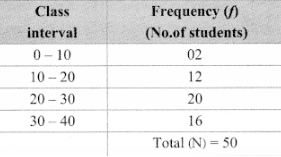
The following information is regarding marks in mathematics, obtained out of 40, scored by 50 students of 9th std. ¡n the first unit test.

Image
From the table, fill in the blanks in the following statements.
i. For class interval 10 – 20 the lower class limit is _____ and upper class limit is _____
ii. How many students obtained marks less than 10? 2
iii. How many students obtained marks less than 20? 2 + ____ = 14
iv. How many students obtained marks less than 30? ______ + _____ = 34
v. How many students obtained marks less than 40? ______ + ______ =50

Prove the Theorem : Congruent chords of a circle are equidistant from the centre of the circle.
Solve.
$A B C D$ is a parallelogram. The ratio of $\angle A$ and $\angle B$ of this parallelogram is $5: 4$. FInd the measure of $\angle B$.
In figure, ABC and ABD are two triangles on the base AB. If line segment CD is bisected by AB at O, show that $\text{ar}(\triangle\text{ABC})=\text{ar}(\triangle\text{ABD}).$
In a $\triangle\text{ABC},$ P and Q are respectively the mid points of AB and BC and R is the midpoint of AP. Prove that:
  1. $\text{ar}(\triangle\text{PBQ})=\text{ar}(\triangle\text{ARC}).$
  2. $\text{ar}(\triangle\text{PRQ})=\frac{1}{2}\text{ar}(\triangle\text{ARC}).$
  3. $\text{ar}(\triangle\text{EQC})=\frac{3}{8}\text{ar}(\triangle\text{ABC}).$
There are $10$ observations arranged in ascending order as given below.
$45, 47, 50, 52, JC, JC + 2, 60, 62, 63, 74.$ The median of these observations is $53.$
Find the value of $JC.$ Also find the mean and the mode of the data.
Divide each of the following polynomials by synthetic division method and also by linear division method. Write the quotient and the remainder :
$(y^3 – 3y^2 + 5y – 1) ÷ (y – 1)$
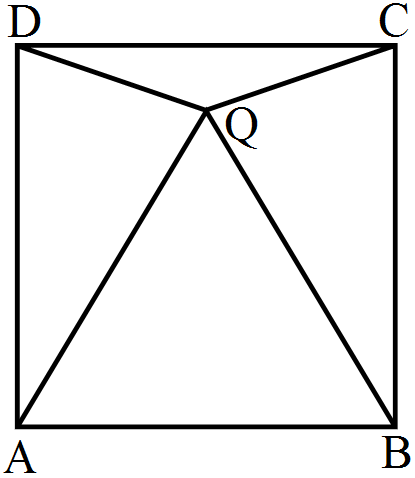
In the given figure, O is a point in the interior of square ABCD such that $\triangle\text{OAB}$ is an equilateral triangle. Show that $\triangle\text{OCD}$ is an isosceles triangle.
Two parallel lines l and m are intersected by a transversal t. Show that the quadrilateral formed by the bisectors of interior angles is a rectangle.
Aarushi was driving a car with uniform speed of 60km/ h. Draw distance-time graph. From the graph, find the distance travelled by Aarushi in:
  1. $2\frac{1}{2}\text{ Hours}$
  2. $\frac{1}{2}\text{ Hour}$