The sun radiates electromagnetic energy at the rate of $3.9 \times 10^{26}\,W$. It's radius is $6.96 \times 10^8\,m$. The intensity of sun light at the solar surface will be (in $W/m^2$)
Medium
Download our app for free and get started
intensity $=\frac{\text { energy radiated }}{\text { area }}=\frac{\mathrm{E}}{4 \pi \mathrm{R}^{2}}$
$=\frac{3.9 \times 10^{26}}{4 \times \frac{22}{7} \times\left(7 \times 10^{8}\right)^{2}}$
$=\frac{10^{10}}{22 \times 7}=\frac{1000}{54} \times 10^{7} \simeq 6.4 \times 10^{7} \mathrm{W} / \mathrm{m}^{2}$

Download our appand get started for free
Experience the future of education. Simply download our apps or reach out to us for more information. Let's shape the future of learning together!No signup needed.*
Similar Questions
- 1A body of area $1\, cm^2$ is heated to a temperature $1000\, K$. The amount of energy radiated by the body in $1\, second$ is .......... $Joule$ (Stefan's constant $\sigma = 5.67 \times 10^{-8}\, W\, m^{-2}K^{-4}$)View Solution
- 2A black body radiates at the rate of $W$ watts at a temperature $T$ . If the temperature of the body is reduced to $T/3$ , it will radiate at the rate of (in Watts)View Solution
- 3View SolutionCooling law is based upon
- 4View SolutionWhich of the following statements is true/correct
- 5If a metallic sphere gets cooled from ${62^o}C$ to ${50^o}C$ in ${40^o}C$and in the next $10\;\min utes$gets cooled to ${42^o}C$, then the temperature of the surroundings is ......... $^oC$View Solution
- 6Two vessels of different materials are similar in size in every respect. The same quantity of ice filled in them gets melted in $20$ minutes and $40$ minutes respectively. The ratio of thermal conductivities of the materials isView Solution
- 7A cylindrical rod having temperature ${T_1}$ and ${T_2}$ at its ends. The rate of flow of heat is ${Q_1}$ $cal/sec$. If all the linear dimensions are doubled keeping temperature constant then rate of flow of heat ${Q_2}$ will beView Solution
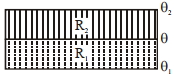
- 8The temperature $\theta$ at the junction of two insulating sheets, having thermal resistances $R _{1}$ and $R _{2}$ as well as top and bottom temperatures $\theta_{1}$ and $\theta_{2}$ (as shown in figure) is given byView Solution
- 9The wall with a cavity consists of two layers of brick separated by a layer of air.All three layers have the same thickness and the thermal conductivity of the brick is much greater than that of air. The left layer is at a higher temperature than the right layer and steady state condition exists. Which of the following graphs predicts correctly the variation of temperature $T$ with distance $d$ inside the cavity?View Solution
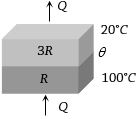
- 10In the following figure, two insulating sheets with thermal resistances $R$ and $3R$ as shown in figure. The temperature $\theta$ is ...... $^oC$View Solution