MCQ
Work done on an object does not depend
  • On the initial speed of the object
  • B
    At the angle between force and displacement
  • C
    On displacement
  • D
    On applied force

Answer

Correct option: A.
On the initial speed of the object
A

Need a full question paper?

Generate a complete, print-ready paper with questions like this in minutes — across 16+ boards, with answer keys.

Start Generating Free

Similar questions

This question has statement $1$ and statement $2$ . Of the four choices given after the statements, choose the one that best describes the two statements. 
Statement $- 1$: A point particle of mass m moving with speed $u$ collides with stationary point particle of mass $M$. If the maximum energy loss possible is given as $f$ $\left( {\frac{1}{2}m{v^2}} \right)$ then $ f = \left( {\frac{m}{{M + m}}} \right)$ 

Statement $-2$: Maximum energy loss occurs when the particles get stuck together as a result of the collision.
Function $x$ = $A sin^2 wt + B cos^2 wt + C sin wt \  cos wt$ does not represents $SHM$ for this condition
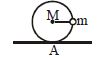
A uniform body of mass $M$  radius $R$ has a small mass $m$ attached at edge as shown in the figure. The system is placed on a perfectly rough horizontal surface such that mass $m$ is at the same horizontal level as the centre of body. It is assumed that there is no slipping at point $A$. If $I_A$ is the moment of the inertia of combined system about point of contact $A$ then the normal reaction at point $A$ just after the system is released from rest is ........ $N$. ($M = 6\ kg$, $m = 2\ kg,$ $I_A = 4\ kg\ m^2$, $R = 1\ m$, $g=10\ m/s^2$)
The condition for a uniform spherical mass $m$ of radius $r$ to be a black hole is [$G=$ gravitational constant and $g=$ acceleration due to gravity]
The water stored in a reservoir possesses:
Surface tension is due to
A man is standing at the centre of frictionless pond of ice. How can he get himself to the shore
Two pendulums have time periods $T$ and $5T/4.$ They start $SHM$ at the same time from the mean position. After how many oscillations of the smaller pendulum they will be again in the same phase :
The magnitude of torque on a particle of mass $1\,kg$ is $2.5\, Nm$ about the origin. If the force acting on it is $1\,N$, and the distance of the particle from the origin is $5\,m$, the angle between the force and the position vector is (in radians)
Water does not wet an oily glass because