MCQ
In the Boolean algebra, the following one is wrong:
- A1 + 0 = 1
- B0 + 1 = 1
- C1 + 1 = 1
- D0 + 0 = 1
Explanation:
In the Boolean algebra, binary addition is given as:
1 + 0 = 1
0 + 1= 1
1 + 1 = 1
Hence, 0 + 0 =1 is wrong.
Generate a complete, print-ready paper with questions like this in minutes — across 16+ boards, with answer keys.
A convex lens of ______ focal length gives a greater magnification than lenses of _______ focal length.
In the electric field of a point charge q, a certain charge is carried from point A to B, C, D and E. Then the work done
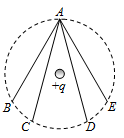
|
(a) Is least along the path AB |
(b) Is least along the path AD |
|
(c) Is zero along all the paths AB, AC, AD and AE |
(d) Is least along AE |
The core of a transformer is laminated so that
|
(a) Ratio of voltage in the primary and secondary may be increased |
|
(b) Rusting of the core may be stopped |
|
(c) Energy losses due to eddy currents may be reduced |
|
(d) Change in flux is increased |
A radioactive decay chain starts from  and produces by successive emissions. The emitted particles can be
| (a) Two a-particles and one b-particle |
(b) Three  particles particles
|
|
(c) One a particle and two particles
|
(d) One a particle and two  particles particles
|
For a nucleus to be stable, the correct relation between neutron number N and Proton number Z is
|
(a) N > Z |
(b) N = Z |
(c) N < Z |
(d) N ≥ Z |
A glass rod rubbed with silk is used to charge a gold leaf electroscope and the leaves are observed to diverge. The electroscope thus charged is exposed to X-rays for a short period. Then
|
(a) The divergence of leaves will not be affected |
|
(b) The leaves will diverge further |
|
(c) The leaves will collapse |
|
(d) The leaves will melt |
Value of potential at a point due to a point charge is
|
(a) Inversely proportional to square of the distance |
|
(b) Directly proportional to square of the distance |
|
(c) Inversely proportional to the distance |
|
(d) Directly proportional to the distance |
A beam of plane polarized light falls normally on a polarizer of cross sectional area 3  . Flux of energy of incident ray in 10–3 W. The polarizer rotates with an angular frequency of 31.4 rad/sec. The energy of light passing through the polarizer per revolution will be
|
(a) 10–4 Joule |
(b) 10–3 Joule |
(c) 10–2 Joule |
(d) 10–1 Joule |