MCQ
In the case of amplitude modulation to avoid distortion the modulation index $(\mu)$ should be.
  • $\mu \leq 1$
  • B
    $\mu \geq 1$
  • C
    $\mu=2$
  • D
    $\mu=0$

Answer

Correct option: A.
$\mu \leq 1$
a
$\mu=\frac{ A _{ m }}{ A _{ c }}$

$\mu \leq 1$ to avoid distortion

because $\mu>1$ will result in interference between career frequency \& message frequency.

Need a full question paper?

Generate a complete, print-ready paper with questions like this in minutes — across 16+ boards, with answer keys.
Start Generating Free

Similar questions

A ray of light travelling inside a rectangular glass block of refractive index $\sqrt 2 $ is incident on the glass-air surface at an angle of incidence of $45°$. The refractive index of air is $1.$ Under these conditions the ray
A body cools from $80^{\circ}\,C$ to $60^{\circ}\,C$ in $5$ minutes. The temperature of the surrounding is $20^{\circ} C$. The time it takes to cool from $60^{\circ}\,C$ to $40^{\circ}\,C$ is........... $s$
At room temperature a diatomic gas is found to have an $r.m.s.$ speed of $1930\,ms^{-1}$. The gas is
Coherent sources are characterized by the same
The unit of focal power of a lens is
The gravitational constant depends upon .........
If the r.m.s. speed of chlorine molecule is $490\,m / s$ at $27^{\circ}\,C$, the r.m.s. speed of argon molecules at the same temperature will be $......\,m/s$ (Atomic mass of argon $=39.9\,u$, molecular mass of chlorine $=70.9\,u )$
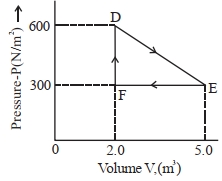
A thermodynamic system is taken from an original state $D$ to an intermediate state $E$ by the linear process shown in the figure. Its volume is then reduced to the original volume from $E$ to $F$ by an isobaric process. The total work done by the gas from $D$ to $E$ to $F$ will be $......J$
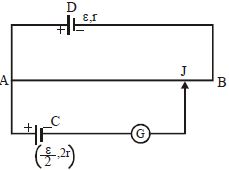
In the figure, the potentiometer wire $AB$ of length $L$ and resistance $9r$ is joined to the cell $D$ of $emf$ $\varepsilon $ and internal resistance $r$. The cell $C's$ $emf$ is $\frac{\varepsilon }{2}$and its internal resistance is $2r$. The galvanometer $G$ will show no deflection when the length $AJ$ is
For a wire $\frac{R}{l}=\frac{1}{2}$ and length of wire is $l=5\, cm .$ If potential difference $1\, V$ is applied across it, current through wire will be: $( R =$ Resistance $)$ (in $A$)