In the circuit shown below, the power developed in the $6$ $\Omega$ resistor is $6\, watt$. The power in watts developed in the $4$ $ \Omega$ resistor is
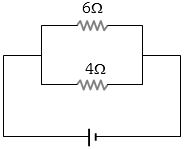
Medium


Download our appand get started for free
Experience the future of education. Simply download our apps or reach out to us for more information. Let's shape the future of learning together!No signup needed.*
Similar Questions
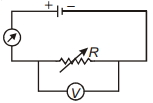
- 1A voltmeter is connected in parallel with a variable resistance $R$ which is in series with an ammeter and a cell as shown in the figure. For one value of $R$, the meters read $0.3 \,A$ and $0.9 \,V$. For another value of $R$ the readings are $0.25 \,A$ and $1.0 \,V$. What is the internal resistance of the cell is ......... $\Omega$View Solution
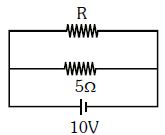
- 2The power dissipated in the circuit shown in the figure is $30\, Watts$. The value of $R$ is ............. $\Omega$View Solution
- 3$10$ resistors each of resistance $10\,\Omega$ can be connected in such as to get maximum and minimum equivalent resistance. The ratio of maximum and minimum equivalent resistance will be $..........$.View Solution
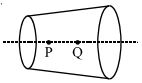
- 4A wire has a non-uniform cross-section as shown in figure.A steady current flows through it. The drift speed of electrons at points $P$ and $q$ is $v_P$ and $v_Q$.View Solution
- 5The length of a metallic wire is increased by $20 \%$ and its area of cross section is reduced by $4 \%$. The percentage change in resistance of the metallic wire is $.......$View Solution
- 6A wire of length $10 \mathrm{~cm}$ and radius $\sqrt{7} \times 10^{-4} \mathrm{~m}$ connected across the right gap of a meter bridge. When a resistance of $4.5 \ \Omega$ is connected on the left gap by using a resistance box, the balance length is found to be at $60 \mathrm{~cm}$ from the left end. If the resistivity of the wire is $\mathrm{R} \times 10^{-7} \Omega \mathrm{m}$, then value of $\mathrm{R}$ is :View Solution
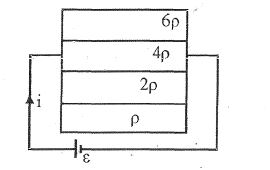
- 7If resistivity of all four wire connected in parallel is different as given in figure and all other dimensions of wire are same then current $i$ is (resistance of wire having resistivity $\rho $ is $R_0$ )View Solution
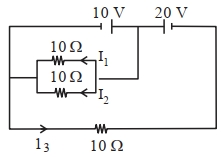
- 8In the given circuit the value of $\left|\frac{I_1+I_3}{I_2}\right|$ isView Solution
- 9A heating coil is labelled $100\, W$, $220\, V$. The coil is cut in half and the two pieces are joined in parallel to the same source. The energy now liberated per second is .............. $J$View Solution
- 10The resistance per centimeter of a meter bridge wire is $\mathrm{r}$, with $\mathrm{X}\ \Omega$ resistance in left gap. Balancing length from left end is at $40 \mathrm{~cm}$ with $25\ \Omega$ resistance in right gap. Now the wire is replaced by another wire of $2 \mathrm{r}$ resistance per centimeter. The new balancing length for same settings will be atView Solution