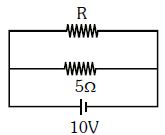
The power dissipated in the circuit shown in the figure is $30\, Watts$. The value of $R$ is ............. $\Omega$
Medium
Download our app for free and get started
Power dissipated in $5\, \Omega$
${=\mathrm{i}^{2} \mathrm{R}} $
${=(2)^{2} \times 5=20 \mathrm{\,W}}$
$\therefore $ Power dissipated in $\mathrm{R}=30-20$
$=10 \mathrm{\,Watt}$
$\therefore \quad 10=\frac{(10)^{2}}{\mathrm{R}}$
$\mathrm{R}=\frac{100}{10}=10\, \Omega$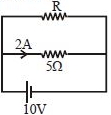

Download our appand get started for free
Experience the future of education. Simply download our apps or reach out to us for more information. Let's shape the future of learning together!No signup needed.*
Similar Questions
- 1A potentiometer has uniform potential gradient. The specific resistance of the material of the potentiometer wire is $10^{-7} \, ohm-meter$ and the current passing through it is $0.1\, ampere$; cross-section of the wire is $10^{-6}\, m^2$. The potential gradient along the potentiometer wire isView Solution
- 2View SolutionWhen a potential difference is applied across the ends of a linear metallic conductor
- 3A potentiometer wire of length $L$ and a resistance $r$ are connected in series with a battery of e.m.f. $E_0$ and a resistance $r_1$. An unknown e.m.f. $E$ is balanced at a length $l$ of the potentiometer wire. The e.m.f. $E$ will be given byView Solution
- 4View SolutionWhich of the following statement is false
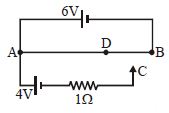
- 5A $6\, volt$ battery of negligible internal resistance resistance is connected across a uniform wire $AB$ of length $100\,cm$. The positive terminal of another battery of $emf$ $4\,V$ and internal resistance $1\,\Omega $ is joined to the point $A$ as shown in fig. Take the potential at $B$ to be zero. At which point $D$ of the wire $AB$, from left the potential is equal to the potential at $C$ ? ...................... $cm$ (approximately)View Solution
- 6The resistance of a heater coil is $110\, ohm$. A resistance $R$ is connected in parallel with it and the combination is joined in series with a resistance of $11\, ohm$ to a $220\, volt$ main line. The heater operates with a power of $110\, watt$. The value of $R$ in $ohm$ isView Solution
- 7When two identical batteries of internal resistance $1 \Omega$ each are connected in series across a resistor $\mathrm{R}$, the rate of heat produced in $R$ is $J_1$. When the same batteries are connected in parallel across $R$, the rate is $\mathrm{J}_2$. If $\mathrm{J}_1=2.25 \mathrm{~J}_2$ then the value of $\mathrm{R}$ in $\Omega$ isView Solution
- 8A uniform heating wire of resistance $36\, \Omega$ is connected across a potential difference of $240\, {V}$ The wire is then cut into half and potential difference of $240\, {V}$ is applied across each half separately. The ratio of power dissipation in first case to the total power dissipation in the second case would be $1: {x}$, where ${x}$ is........... .View Solution
- 9A wire of length $100\, cm$ is connected to a cell of $emf$ $2\, V$ and negligible internal resistance. The resistance of the wire is $3\, \,\Omega$. The additional resistance required to produce a potential drop of $1$ milli volt per cm is ............... $\Omega $View Solution
- 10View SolutionA thick wire is stretched so that its length become two times. Assuming that there is no change in its density, then what is the ratio of change in resistance of wire to the initial resistance of wire